Land Preparation and Sowing Method
Cotton is an indigenous crop of Pakistan and is mainly grown as source of fiber, food and feed. Cotton fiber is an economic component and plays a vital role in uplifting country's economy. It earns 65% foreign exchange annually and accounts for 8.2% of value added income in Agriculture and 2% in GDP of Pakistan. Pakistan ranks fourth in area (3.2 million hectares) and production (14.3 million bales) and the third largest exporter of raw cotton, the third largest consumer of cotton, Moreover, it also provides raw material for textile and Banaspati ghee manufacturing industries. Cotton seed cake is one of the major sources of cattle feed to enhance milk production in Pakistan. Even the stalk of the cotton plant is used as a fuel in rural areas, to develop ethanol in diesel or petrol blends and to improve soil organic matter. Cotton is mainly cultivated in two provinces. The Punjab, being the most conducive for cotton production, produces around 70% of country's cotton followed by Sindh that contributes 28% of production.
Land Preparation
Cotton can be grown on a wide range of soils. The soils of Pakistan are generally calcareous with high pH (alkaline) and low organic matter content. Cotton requires a large amount of moisture during flowering and fruiting stage for high yield of lint. Therefore, well drained loamy soils with adequate organic matter and good water holding capacity are best suited for cotton cultivation.
Proper land preparation is essential for ensuring optimal germination and growth of crops. After removing the Rabi crop, the field should be irrigated immediately. Following that, deep ploughing of the land using a Moldboard (MB) plough should be practiced, along with planking to enhance root penetration. To ensure a level soil surface and equal distribution of irrigation, a laser land leveler should be used. It is advisable to practice deep ploughing once every three years, as this practice helps control perennial weeds and eliminate various soil-borne pests and diseases.
| Sowing Time | Sowing Method | Seed Rate kg/acre | Plant to plant distance | Row to Row distance | Number of Plants /acre |
|---|---|---|---|---|---|
| 1st April to 30th April | Drill Sowing Ridge Sowing |
8-10 kg 5-6 kg |
12 – 15 Inches | 30 inches 30 inches |
14000 to 17500 |
| 1st May to 31st May | Drill Sowing Ridge Sowing |
8-10 kg 5-6 kg |
6 – 9 Inches | 30 inches 30 inches |
23000 to 35000 |
Method of sowing:(Drill sowing and Hand sowing.)
Drill Sowing:
In drill sown crop, the recommended row to row distance is 2-2.5ft and plant to plant distance is 12-15 inches. Seed should be drilled to a depth of 2.5 inches deep. In this sowing method water consumption reduced to 30-40%.
Hand sowing / Planter method:
- Ridge to Ridge distance = 60-75 cm
- Plant to Plant distance = 9-12 inches
After seed bed, beds are made by ridger-bed shaper which makes 75 cm wide bed furrows. Furrow depth is 7 inches. On both margins of beds, sowing can be carried out manually by labor or bed planter can be used. In case of manual sowing, irrigation is applied in furrows and just after irrigation, 2-4 seeds are sown manually 2.5 cm above water level. In case of planter sowing, sowing is done on the both margins of beds by bed planter. Just after sowing, irrigation is applied in furrows 5 cm below the seed.
Note: Gap filling: After 4-5 DAS, the seeds which do not germinate, produce gaps that should be filled by sowing 5-6 hrs soaked seed (4-5 seeds). Plant population = 23000-35000 plants per acre.
Approved Varieties of Cotton
| Varieties | Year of Release | Sowing Time | Yield Potential (Maunds/Acre) | Recommended Areas |
|---|---|---|---|---|
| MNH-1050 | 2021 | 1st April to 31st May | 40 to 50 | All Areas of Punjab |
| MNH-1035 | 2021 | 1st April to 31st May | 40 to 50 | All Areas of Punjab |
| MNH-1026 | 2021 | 1st April to 31st May | 40 to 50 | All Areas of Punjab |
| MNH-1020 | 2021 | 1st April to 31st May | 40 to 50 | All Areas of Punjab |
| MNH-1016 | 2021 | 1st April to 31st May | 40 to 50 | All Areas of Punjab |
| FH-Anmol | 2021 | 1st April to 31st May | 40 to 50 | All Areas of Punjab |
| FH-Super Cotton-17 | 2021 | 1st April to 31st May | 40 to 50 | All Areas of Punjab |
| FH-492 | 2021 | 1st April to 31st May | 40 to 50 | All Areas of Punjab |
| FH-490 | 2021 | 1st April to 31st May | 40 to 50 | All Areas of Punjab |
| FH-444 | 2019 | 1st April to 31st May | 40 to 50 | All Areas of Punjab |
| FH-152 | 2018 | 1st April to 31st May | 35 to 40 | All Areas of Punjab |
| RH-662 | 2018 | 1st April to 31st May | 35 to 40 | DG Khan & Bahawalpur Divisions |
| RH-668 | 2018 | 1st April-31st May | 35 to 40 | DG Khan & Bahawalpur Divisions |
| SLH-8 | 2018 | 1st April-31st May | 35 to 40 | All Areas of Punjab |
| FH-326 | 2017 | 1st April to 31st May | 35 to 40 | Faisalabad, DG Khan & Bahawalpur Divisions |
| FH-Lalazar | 2016 | 1st April-31st May | 35 to 40 | All Areas of Punjab |
| MNH-988 | 2016 | 1st April-31st May | 35 to 40 | All Areas of Punjab |
| VH-305 | 2016 | 1st April-31st May | 35 to 40 | All Areas of Punjab |
| BH-184 | 2016 | 1st April-31st May | 35 to 40 | All Areas of Punjab |
| RH-647 | 2016 | 1st April-31st May | 35 to 40 | All Areas of Punjab |
| VH-327 | 2016 | 1st April-31st May | 35 to 40 | DG Khan & Bahawalpur Divisions |
| FH-118 | 2013 | 15th April-31st May | 35 to 40 | All Areas of Punjab |
| FH-142 | 2013 | 15th April-31st May | 35 to 40 | All Areas of Punjab |
| BH-178 | 2013 | 15th April-31st May | 35 to 40 | All Areas of Punjab |
| VH-259 | 2013 | 15th April-31st May | 35 to 40 | All Areas of Punjab |
| FH-114 | 2012 | 15th April-31st May | 35 to 40 | All Areas of Punjab |
| MNH-886 | 2012 | 15th April-31st May | 35 to 40 | All Areas of Punjab |
| FH-942 | 2012 | 15th April-31st May | 35 to 40 | All Areas of Punjab |
| B H-167 | 2012 | 15th April-31st May | 35 to 40 | All Areas of Punjab |
| SLH-317 | 2012 | 15th April-31st May | 35 to 40 | All Areas of Punjab |
| FH-113 | 2010 | 15th April-31st May | 35 to 40 | All Areas of Punjab |
| CRSM-38 | 2009 | 15th April-31st May | 35 to 40 | All Areas of Punjab |
| MNH-786 | 2006 | 15th April-31st May | 35 to 40 | All Areas of Punjab |
| BH-160 | 2004 | 15th April-31st May | 30 to 35 | All Areas of Punjab |
| FH-1000 | 2003 | 15th April-31st May | 30 to 35 | All Areas of Punjab |
| FH900 | 2000 | 15th April-31st May | 30 to 35 | All Areas of Punjab |
| FH901 | 2000 | 15th April-31st May | 30 to 35 | All Areas of Punjab |
| MNH554 | 2000 | 15th April-31st May | 30 to 35 | All Areas of Punjab |
| MNH552 | 2000 | 15th April-31st May | 30 to 35 | All Areas of Punjab |
| BH-118 | 1999 | 1st May-31st May | 30 to 35 | All Areas of Punjab |
| FVH-53 | 1998 | 1st May-31st May | 35 to 40 | All Areas of Punjab |
| MNH329 | 1996 | 1st May-31st May | 30 to 35 | All Areas of Punjab |
| FH-634 | 1996 | 1st May-31st May | 30 to 35 | All Areas of Punjab |
| RH-112 | 1996 | 1st May-31st May | 30 to 35 | All Areas of Punjab |
| S-14 | 1995 | 1st May-31st May | 35 to 40 | All Areas of Punjab |
| SLS-1 | 1995 | 1st May-31st May | 30 to 35 | All Areas of Punjab |
| MNH147 | 1992 | 1st May-31st May | 30 to 35 | All Areas of Punjab |
| BH-36 | 1992 | 1st May-31st May | 30 to 35 | All Areas of Punjab |
| Gohar-87 | 1990 | 1st May-31st May | 30 to 35 | All Areas of Punjab |
| RH-1 | 1990 | 1st May-31st May | 30 to 35 | All Areas of Punjab |
| S-12 | 1988 | 1st May-31st May | 35 to 40 | All Areas of Punjab |
| FH-87 | 1988 | 1st May-31st May | 30 to 35 | All Areas of Punjab |
| MNH129 | 1985 | 1st May-31st May | 30 to 35 | All Areas of Punjab |
| SLH-41 | 1985 | 1st May-31st May | 25 to 30 | All Areas of Punjab |
| MS-84 | 1983 | 1st May-31st May | 20 to 25 | All Areas of Punjab |
| MNS-79 | 1983 | 1st May-31st May | 20 to 25 | All Areas of Punjab |
| MNH-93 | 1980 | 1st May-31st May | 30 to 35 | All Areas of Punjab |
| B-557 | 1975 | 1st May-10th June | 20 to 25 | All Areas of Punjab |
Recommended Fertilizer
Judicious use of fertilizers, irrigation and clean cultivation will prevent early build-up of pests. To enhance subsidiary growth to have maximum number of boll bearing branches, cut top of growing point of main branch at around 5 feet height. At the time of last ploughing apply well decomposed cow dung @ 5-10 ton for rainfed and 10-20 ton per acre for irrigated soil. It will help to conserve moisture in soil.
| Sr.No | Fertilizer | At Sowing | 25- 30 DAS (days after sowing) |
50- 60 DAS (days after sowing) |
90- 100 DAS (days after sowing) |
120- 130 DAS (days after sowing) |
150- 160 DAS (days after sowing) |
|---|---|---|---|---|---|---|---|
| 1 | Phosphatic Fertilizers | 25 kg DAP + 2 bags BOP | 1 bag Nitrophos | 10 kg Urea Phosphate | |||
| 2 | Potash Fertilizers | 25 kg SOP | SOP (WS) @12.5 kg /acre Flooding | Potash 30% @ 500 ml (Spray) | Potash 30% @ 500 ml (Spray) | ||
| 3 | Nitrogenous Fertilizer | 25 kg Urea | 1 bag Urea | 25 kg Urea | 25 kg Urea | 25 kg Urea | |
| 4 | Chelated Zinc 5 % | 2 kg | |||||
| 5 | Sulpher 80% | 2 kg |
Note: Application of potassium humate @ 5 -10 liters / acre after after 60 days of sowing with urea enhance plant growth and development and nourish soil as well.
- Ammonium sulphate & calcium ammonium nitrate can also be used as Nitrogen source.
- Fertilizer plan can be adjusted as per crop situation.
- Foliar spray of Boron 5% @ 500ml/100 liter of water at later stage of crop will also enhance yield significantly.
Deficiency Symptoms
Leaf Reddening:
Initially observed in mature leaves then spread throughout canopy. Leaf reddening can be corrected by proper fertilizer management. Take Foliar spray of MgSO4@1kg, followed by Urea@2kg/100Ltr water
Nitrogen Deficiency:
- Plant growth get stunted and leaves become light green color.
- Lower leaves show yellowing. In severe conditions, leaves get brown and dry.
Phosphorus Deficiency:
- Younger Leaves show more dark green appearance.
- Older leaves develop purple and red pigmentation.
Potash Deficiency:
- Due to potash deficiency, shedding of leaves is observed also boll opening is not proper.
- Leaves get curled and become dry.
Zinc Deficiency:
- Growth get affected and plant become stunted.
- Terminal buds show drying off followed by distorted tips or young leaves.
Irrigation
Give first Irrigation to the crop 30 to 35 days after sowing. And remaining irrigation should be done at interval of 12 – 15 days, depending on weather and crop condition. Never let water to stand in cotton field for more than 24 hours. Do not let the crop to suffer from water deficiency during flowering and fruiting to avoid the shedding of flowers and bolls. Give last irrigation to the crop when 33% of bolls are opened and after that there is no need of more water through irrigation.
| Critical stages | Irrigation Interval |
|---|---|
| Branching and Square formation | 45-50 days after sowing |
| Flowering and Fruiting stage | 75-85 days after sowing |
| Boll formation | 95-105 days after sowing |
| Boll development and boll opening | 115-125 days after sowing |
| Sowing method | 1st irrigation | Subsequent irrigations | Last irrigation |
|---|---|---|---|
| Drill sown crop | 30-50 DAS | 12-15 days interval | Up to 30th September |
| Bed sown crop | 3-4 DAS | 7-10 days interval | Up to 15th October |
Weeds Management
Due to wide spaced crop weeds pose serious threat. A weed free period of 50-60 days from sowing is necessary for good yield otherwise it may cause 60-80% reduction in yields. Manual, mechanical and chemical methods of weed control in combination is necessary for effective weed control. Carry out first manual hoeing 5-6 weeks after sowing or before first irrigation. Remaining hoeing should be done after each irrigation. Do not allow congress grass to grow around cotton fields, as they increase the possibility of mealy bug infestation.
Mode of Damage:
- Competition for Nutrients
- Competition for moisture
- Competition for light
- Competition for space (CO2)
- Allelopathic Effect
- Serve as host of pests and diseases
Pre-emergence weedicides:
| Weedicide | Dose/ acre |
|---|---|
| Pendimethalin 33 EC | @1000 to 1250 ml |
| Metolachlor 960 EC | @800 ml |
| S.metolachlor 960 EC | @ 800 ml |
| Metolachlore+pendimethalin 960 EC | @ 900 ml |
| S.metachlore + Pendimethalin 960 EC | @ 900 ml |
Post-emergence weedicides:
| Chemical Name | Weeds Type | Dose/acre |
|---|---|---|
| Glyphosate 48% | All weeds (narrow leaf, broad leaf and Deela) | 1200 ml 200ml/20 liters of water |
| Ammonium salt of glyphosate 75% (Top care by jaffer agro chemicals) | All weeds (narrow leaf, broad leaf and Deela) | 150 gram/ 20 liters of water |
| Paraquat 20 % | All weeds (narrow leaf, broad leaf and Deela) | 1000 ml |
| Quizalofop-p-ethyl 10.8 % | Khabbal grass + Swanki | 350 -500 ml |
Note: Use 120 liters of water / acre. Do not spray in strong wind, rain or fog. Use clean water to spray. Use a (flat fan or T-Jet) nozzle as a standard practice for spraying.
Diseases and Their Management
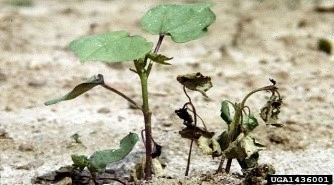
Fusarium wilt
Plants become stunted, yellow, followed by defoliation. Yellowing first occurs around leaf edges and advances inward. Infected plants fruit earlier and produce smaller bolls. It causes a blackening and discoloration just found in a ring just beneath the bark. affect at all stages of crop.
Control:
To control the disease flood Thiophenete methyl 70% @ 1000 grams/ acre. Or Flood Fosytile aluminum 80% @ 1000 gram/ acre.
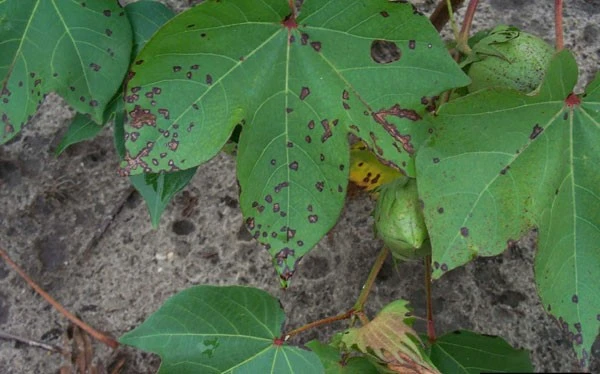
Alternaria Leaf spot
Small, pale to brown, round or irregular spots of circular to semi-circular size with broad margins appear on leaves. Affected leaves become dry and get fall off. It may cause cankers on stem. Infection is spread to boll, then rotting of boll occurred afterwards they get fall off. Plants stressed by drought, nutrient deficiency and other pests are more susceptible to the disease.
Control:
Spray copper oxychloride + kasogamycine 47% @ 250 gram in 100 liters of water.
Root rot
Sudden and complete wilting of plants. Leaves give yellow appearance. Affected plants can be easily pulled out. Except the tap root, few secondary roots are fresh which holds the plant and other roots are decayed.
Control:
To control the disease flood Thiophenete methyl 70% @ 1000 grams/ acre. Or Flood Fosytile aluminum 80% @ 1000 gram/ acre.
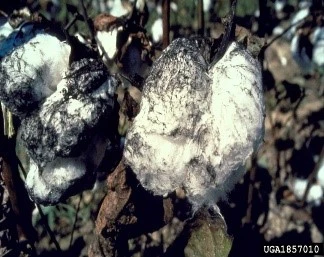
Sooty Mould Fungus
Plants are infected by sooty mould fungus after attack of white fly on crop. Affected plants give sticky, black appearance.
Control:
Spray Azoxystrobin + Tebaconazole 50 % @ 100ml/ 100 liter of water.
Insects / Pests and Their Management
Jassid:
Symptoms:
Nymphs and adults of jassids suck sap from underside leaves and causing of curling. Leaves turn red or brown then dry up and shed.
Chemical Control:
| Insect/ Pest | ETL Level | Chemical | Dose/acre |
|---|---|---|---|
| Jassid | 1 nymph or adult/ leaf | Dinotifuran 30% Nitonpyrum 50% Acephate 75% Sulfoxaflore Flonicamid 50%(Oolala) |
75-100 ml/acre 50 gram/acre 250 gram/acre 30 gram/acre 60 gram/acre |
Thrips:
Symptoms:
Both nymphs and adults lacerate & feed the sap from under surface of leaves. Upper side of leaf turns brown and lower side becomes silvery white. Seed treatment with imidacloprid 70 WS@7 ml/kg protect the crop from aphids, leaf-hoppers and thrips up to 8 weeks.
Chemical Control:
| Insect/ Pest | ETL Level | Chemical | Dose/acre |
|---|---|---|---|
| Thrips | 8 to 10 nymph or adult/ leaf | Chlorfenapyr 36% Dimethoate 40% (danadim) Acephate 75% Chlorfenapyr + Spinosad 12% SC Chlorfenapyr 36% + Fipronil 5% (in case of severe attack) |
150 ml/acre 250 -300 ml /acre 250 gram/acre 150 ml /acre 100 ml + 320 ml/ acre |
Whitefly:
Symptoms:
Nymph are of yellow oval while adult are of yellow body covered with a white waxy bloom. They suck the sap from leaves, which lead into poor photosynthesis. It also act as a medium of transferring leaf curl virus disease. In severe infestation defoliation, shedding of boll and poor opening of boll is observed. Developed sooty mould and plant give sick, black appearance.
Cultural Control:
Avoid continuous growing of cotton in same field. Adopting crop rotation with non-preferred hosts such as sorghum, ragi, maize etc., Avoid excess vegetative growth for that avoid excess use of nitrogen. Do timely sowing of crop. Keep field clean. Cultivation of most preferred alternate host crops like eggplant, okra, tomato, tobacco and sunflower may be avoided. Install yellow sticky traps for monitoring white fly (2 traps/acre).
Chemical Control:
| Insect/ Pest | ETL Level | Chemical | Dose/acre |
|---|---|---|---|
| Whitefly | 5 nymph or adult or both/ leaf | Acetamaprid + Pyriproxyfin 41.6% (nymph + adult) Buprofezin 25 % (nymph) Pyriproxyfin 10.8 % (nymph) Pyrifluquinazon (jaffer agro services) Diafenthiuron 50% (adult) Flonicamid (Ulala) Spirotetramate 24% (Movento by bayre) |
250 ml/acre 600 gram /acre 400- 500 ml /acre 200 gram/acre 100- 150 ml/acre 80 gram/acre 125- 250 ml /acre |
Mealybug:
Symptoms:
Found under surface of leaves in clusters and secrete wax like substance. Due to honey dew like secretion, sooty mould is developed and affected plant gives sick, black appearance.
Cultural Control:
Do not throw mealy bug infested uprooted plants in water channels or vacant spaces, instead burn them. Do not allow congress grass to grow around cotton fields, as they increase the possibility of attack by mealy bug. To control spread of mealy bugs in newer areas, avoid movement of human beings or animals from infected area to healthy crop.
Dusky cotton bug and Red cotton bug:
Symptoms:
Sucking behavior of these insects disturbs the cotton crop both at early and late stages. Both of these insects (nymphs and adults) sucks the cell sap from bolls and deteriorates the seed quality and stains the lint black.
Cultural Control:
to control mealybug, dusky cotton bug and red cotton bug spray clothianadin 20% SC @ 150 to 200 ml/ acre.
Pink bollworm:
Young larva is of white color and late instar is vary in color ranging from almost black, brown or green to pale or pink.
Mode of damage:
Pink bollworms damage squares and bolls, the damage to bolls being the most serious. Larvae burrow into bolls, through the lint, to feed on seeds. As the larva burrows within a boll, lint is cut and stained, resulting in severe quality loss.
Chemical Control:
| Insect/ Pest | ETL Level | Chemical | Dose/acre |
|---|---|---|---|
| Pink bollworm | 5 larvea/ 100 immature bolls | Abamactin 1.9% EC Bifenthrin 10% Triazophos 40 % Abamactin + Triazophos 20 % Lambda cyhalothrin + Triazophos 21% Spinetoram 12 % Lambda cyhalothrin 2.5 % Gamma cyhalothrin 6 % |
400 ml or 350 ml 500-660 ml 660 ml 550- 660 ml 80 ml 330 ml 100 ml |
Army Worm:
Mode of damage:
It attacks on crop in group and Scrapping the epidermal layer, leaving the skeleton of veins of leaf. During severe attack only stem and side shoots will be standing. Eggs of tobacco caterpillar are of golden brown and appears in masses. Larva is of greenish color.
Cultural Control:
Use light traps to know intensity of pest. Set up the sex pheromone trap 5/acre. Do manual inspection for pest. Larva are found in cluster, collect and destroyed early stage larva also grown up caterpillar
American Bollworm:
Mode of damage:
Eggs are laid singly on both upper and lower leaf surfaces. Newly hatched larva is yellowish white with brown black head. Later, body color changes to darker and after that changes to brownish. Due to infestation of this pest, circular holes are observed on boll. Presence of granular faecal pellets outside the bore hole. Single larva can damage 30-40 bolls. To check infestation use light traps, pheromone traps.
Cultural Control:
Avoid continuous cropping of cotton. Avoid mono-cropping. Growing of less preferred crops like green gram, black gram, soybean, castor, sorghum etc., along with the cotton as inter-crop or border crop to reduce the pest infestation. Before sowing of cotton, remove crop residue of previous crops. Use optimum quantity of water and avoid excess use of nitrogen fertilizer. Use resistive varieties.
Spotted Bollworm:
Mode of damage:
Larva is of dull green, black bristles color and having lines of black spots on body. Due to incidence of bollworm, drying and drooping of terminal shoots during pre–flowering stage is observed. It create holes on boll and then causes rotting of boll.
Chemical Control:
| Insect/ Pest | ETL Level | Chemical | Dose/acre |
|---|---|---|---|
| Tobacco Caterpillar | When infestation observed in field | Leufenuron 5% | 200 ml |
| American bollworm | 5 eggs or 3 larvae /25 plants | Amamectin benzoate 1.9 EC | 400 ml |
| Spotted bollworm | 3 larvea/ 25 plants | Lambda cyhalothrin 2.5 % EC OR cypermethrin |
330 ml |
Harvesting
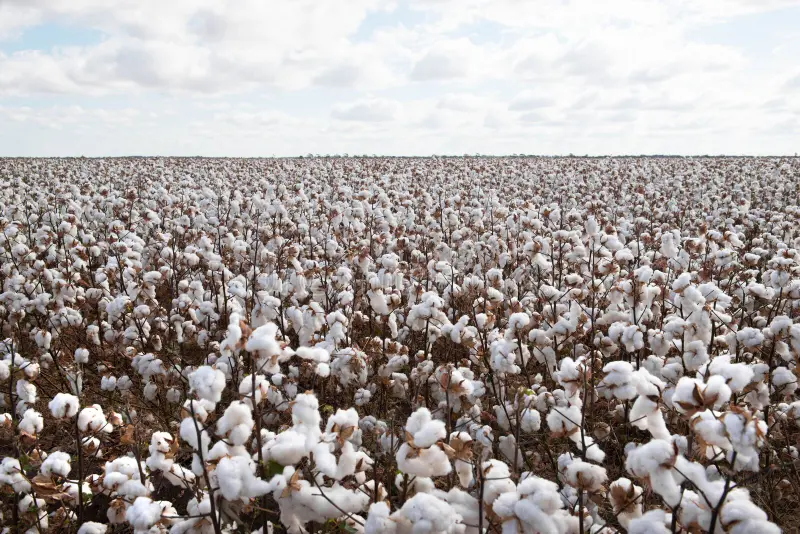
Picking of bolls should be done when bolls are fully mature. Avoid picking of wet bolls, pick cotton free from dry leaves trash. Damaged boll should be picked separately and discarded for seed purpose. The first and last picking are usually of low quality and should not be mixed with rest of the produce to fetch better price. Picked boll should be clean and dry to get good price. Do picking when there is no dew. Picking should be regularly done after every 7-8 days to avoid losses incurred due to fall of the cotton on ground. Delay in picking leads to falling of cotton on the ground which results in deterioration of quality. Harvest the American cotton at the interval of 15-20days and Desi cotton at 8-10 days interval. The picked kapas should be properly cleaned before taking to the market for sale.




.webp)
