Land Preparation and Sowing Method
Rice is second staple food as well as cash crop in Pakistan. It is an extremely important source of rural employment, which can eventually result in poverty reduction. Besides meeting domestic needs, it also plays an important role in earning foreign exchange. Rice crop residue provides raw material for many industries i.e. rice straw is used as fodder for cattle, high quality oil is extracted from rice bran and its husk is used in paper and pulp mills etc.
Rice crop duration

| Varieties | Nursery raising and transplantation | Tillering | Panicle initiation and grain formation | Grain filling and maturity |
|---|---|---|---|---|
| Short duration crop | 1 to 25 days | 26 to 54 days | 55 to 85 days | 86 to 115 days |
| Long duration crop | 1 to 25 days | 26 to 65 days | 68 to 110 days | 111 to 140 days |
Nursery raising
There are different methods for raising nursery depending upon the availability of water, soil characteristics and farming practices of that area. Wet, dry and raab methods are commonly used for raising rice nursery.
1. Wet Method
Cover the heaps (15 to 20 kg) of treated seeds with wet sacks. Keep sprinkling water on the sack to avoid dry out. After about 36 to 48 hours, the seed will begin to sprout.
Poor quality and damaged seeds should be removed by putting them in 2.5% salt solution (prepared by dissolving 25 gm salts in 1-liter water). Discard the seeds, which start floating on the surface of solution.
Seedbed should be prepared 2 weeks before planting. After leveling the land, it should be ploughed thoroughly so that a thin layer of water is maintained over it. After manuring and puddling, divide the land in small plots and broadcast sprouted seeds in each seed bed. Maintain a water level of 1.5 inches at time of broadcasting. Irrigate the field in the morning and drain in the evening (for a week) to avoid seed deterioration (due to heat). After a week increase the level of water upto 3 inches, depending on the height of the seedlings. In case of week seedlings, apply 250 gm urea or 400 gm calcium ammonium nitrate at least 10 days before transplantation. Seedlings are ready for transplanting in 25-35 days.
2. Dry Method
This method is usually practiced in those areas, where soils are silty loam or loamy, and puddling is not possible. After irrigation the field should be ploughed and planked. A raised seed bed is prepared under dry conditions. Treated dry seeds (1.5 kg in case if IRRI varieties or 750-1000 gm in case of basmati varieties) should be evenly broadcasted in each bed. Cover these seed beds with 1-inch thick layer of rotten farmyard manure or rice straws and sprinkle water over it. Allow sunshine to reach seedling by removing the manure or straw layer after few days. The nursery will be ready in 35-40 days and its uprooting will be easy.
3. Raab Method
This method is practiced in areas where soil is hard. A 2-inch deep layer of farmyard manure, wheat or rice straw is first spread uniformly over the plot and burnt out. It is then ploughed in to the land. After that dry treated seed is broadcasted over it, which is followed by irrigation. The nursery is ready in 35 -40 days. The method leads to less weeds, easy uprooting and soil sterilization, resulting in reduced diseases.
Seed treatment
Proper seed treatment is compulsory to protect the plant from seed-borne diseases i.e paddy blast etc. For this purpose, seeds should be soaked with 2.5 gm of a suitable fungicide (i.e. Thiophanate methyl) in one litre of water for 24 hours. Seed are then allowed to sprout, by covering then with jute sacks in a shady place. For seed-dressing (dry method), use 2.5g of chemical fungicide per kg of seeds.
Land preparation for nursery transplantation
Land should be ploughed before irrigation. Allow water to stand for 10 – 15 days before puddling and then transplant the nursery. Puddling should be done 2 to 3 times to improve water holding capacity of land and to make it weed free. Recommended dose of fertilizers should be added with last puddling.
Water-tight rotavator can also be used for puddling purpose.
Maintain the water level of 1.5 inches at the time of transplantation and keep raising it (till 3 inches) according to the size of seedlings. Remove diseased and pest affected seedlings. Avoid using seedling younger than 25 days or older than 40 days.
Necessary recommendations for rice cultivation in salt-affected land
Salt resistant varieties i.e. NIAB IRRI-9, KS-282, KSK-133, PK-386, NIAB-2013 and Shaheen basmati should be cultivated in salt-affected lands. Nursery should be raised in salt free lands. Cultivate land deeply before nursery transplantation. Avoid puddling, as salts can penetrate inside the soil along with water. Maintain standing water condition for 7 to 10 days and then transplant nursery. It has been proved that use of sulphuric acid in fields affected with black salt can improve plant health. Keep changing the water in white-salt affected lands to avoid salt stress.
Direct dry seeding method of Rice
In this method rice is seeded directly into the field (having optimum soil moisture condition) using a seed drill. For this purpose, field is first irrigated (rauni irrigation) and then allowed to attain wattar condition (optimum soil moisture condition). After that fine seedbed is prepared by applying 1-2 shallow cultivations, followed by light planking. Broadcasting of the seeds should be avoided in this method. This system encourages crop diversification and conserves resources like water and seed.
| Variety | Seed rate for direct seeding | Sowing time |
|---|---|---|
| Coarse variety | 8 – 10 kg/acre | 7th – 25th June |
| Basmati variety | 10 – 12 kg/acre | 2nd May – 7th June |
Plant population
Optimum plant population should be maintained to attain good yield. For this purpose, a mutual distance of 9 inches should be maintained between plants and rows. Two seedlings should be inserted per hill.
| Distance between plants and rows | 9 inches |
| Sowing points per acre | 80 thousand |
| No. of plants per acre | 1 lac 60 thousand |
Approved Variety
| Basmati varieties | Coarse varieties | Hybrid varieties |
|---|---|---|
| Super karnal | NIAB IRRI-9 | KSK-111 H |
| Super gold | IRRI-6 | |
| Super basmati-2019 | KS-282 | |
| Basmati-515 | KSK-133 | |
| Chenab basmati | NIAB-2013 | |
| Punjab basmati | KSK-434 | |
| PK-1121 (aromatic) | Nibji GSR-6 | |
| Kainat 1121 | ||
| NIAB basmati 2016 | ||
| Noor basmati | ||
| Shaheen basmati |
Seed Rate
| Sr. no | Varieties | Seed rate (Kg/ acre) Wet method | Seed rate (Kg/ acre) Dry method | Seed rate (Kg/ acre) Raab method | Nursery sowing time and transplantation Sowing time | Nursery sowing time and transplantation Transplanting time |
|---|---|---|---|---|---|---|
| 1 | Coarse varieties | 6 to 7 | 8 to 10 | 12 to 15 | 20th May to 7th June | 20th June to 7th July |
| 2 | Basmati varieties: PK-2021, Aromatic nibji basmati 2020, Super basmati, Basmati-515, Chenab basmati, Punjab basmati, PK-1121 aromatic, NIAB basmati-2016 and Noor basmati | 4.5 to 5 | 6 to 7 | 10 to 12 | 7th to 25th June | 7th to 25th July |
| 3 | Basmati varieties: Shaheen basmati and Kissan basmati | 4.5 to 5 | 6 to 7 | 10 to 12 | 15th to 30th June | 15th to 30th July |
| 4 | Fine variety (non-basmati): PK-386 | 4.5 to 5 | 6 to 7 | 10 to 12 | 7th to 25th June | 7th to 25th July |
| 5 | Basmati hybrid variety: KSK-111 H | 4.5 to 5 | - | - | 7th to 25th June | 7th to 25th July |
| 6 | Coarse hybrid varieties | 6 | - | - | 20th May to 15th June | 25 to 30 days old seedling |
Fertilizer Recommendation
| Coarse Variety | Fine Variety | ||||
|---|---|---|---|---|---|
| N | P | K | N | P | K |
| 69 kg/ acre | 41 kg/ acre | 32 kg/ acre | 55 kg/ acre | 36 kg/ acre | 25 kg/ acre |
- Apply full dose of phosphate fertilizer and half dose potassium with last ploughing (before transplantation). Remaining half dose of potassium should be applied after 45 to 50 days of transplantation before booting stage. Nitrogen should be applied in 2 split doses i.e. 1st dose after 15 to 20 days and 2nd dose after 35 to 40 days of transplantation.
- The amount of nitrogen fertilizer can be reduced by 20%, if the previously grown crop was barseem or pulse crop.
- Use of potassium is compulsory in tube well irrigated areas.
- It is better to apply fertilizer (broadcasting) in muddy condition instead of standing water condition in field.
Importance of Zinc in Rice crop
Zinc deficiency can cause development of brown lesions on leaves which may fuse together to form streaks, covering older leaves entirely. Zinc also plays an important role in tillering, so its deficiency can cause less tiller formation and reduced yield.
- Using Zinc fertilizer in nursery: Apply 200 gm of 33% zinc sulphate or 250 gm of 27% zinc sulphate or 300 gm of 21% zinc sulphate per marla, after 2 weeks of rice nursery cultivation. Roots of rice seedlings can also be dipped in 20% Zinc oxide solution before transplantation.
- Using Zinc fertilizer in field after transplantation: Apply 33% zinc sulphate @ of 6 kg/acre or 27% zinc sulphate @ 7.5 kg/acre or 5% chelated zinc @ 2 kg/acre, after 10 to 15 days of nursery transplantation (through broadcasting).
There should be a difference of 15 to 20 days in application of zinc and phosphatic fertilizer to avoid nutrient fixation in soil. However, chelated zinc can be applied with phosphorus.
Importance of Boron in Rice crop
Boron deficiency results in white and rolled tips of emerging leaves. 20% Boron powder @125gm or 5% boron @500ml can be applied at booting stage.
Green manuring
Sesbania crop can be used for green manuring purpose, as it provides best result in improving organic matter contents of soil. For this purpose, sesbania crop can be ploughed into the soil at vegetative stage, at least 15 to 20 days before land preparation.
Irrigation
A water depth of 1 - 1.5 inches should be maintained at the time of transplantation. It should be gradually increased up to 2 inches for a period of 25 days. After 25 days, allow the field to dry for 5 to 6 days and then maintain saturated moisture condition in the field. However, water should be allowed to stand for 5 to 6 days at the time of granular insecticide application. Stop irrigating the field after grain formation and allow the field to dry sufficiently for harvesting.
Weeds and their management

| Weeds | Chemical Name | Dose per acre | Time of application | Method of application |
|---|---|---|---|---|
| Broad and Narrow leaves | Butachlor 60% EC Pretilachlor 50% EC |
800ml 400ml |
Before emergence | Spray within 24 hours after nursery transplantation |
| Broad and Narrow leaves | Pyrazosulfuron ethyl + Bispyribac sodium (30% WP) | 100gm | After emergence | Spray after 25 to 30 days of nursery transplantation |
| Narrow leaves and sedges | Metamifop + Cyhalofop (20% EC) | 500- 600ml | After emergence | 2 to 3 leaf stage of weeds |
| Sedges | Ethoxysulfuron | 20gm | After emergence | 2 to 3 leaf stage of weeds |
Diseases and their management
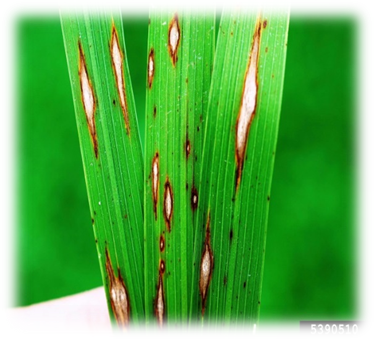
1. Rice blast (fungal)
Initially, grey or white lesions with dark green boarders appear on leaves, panicles or nodes of the plant. While older lesions (on the leaves) have brownish or necrotic border. Leaf lesions range from diamond-shaped to elongated with pointed ends. Lesions can expand and coalesce to kill the entire leaves. Nodes and panicles are darkened and panicle may collapse.
Control:
- Azoxystrobin + Tebuconazole 50% 100ml
- Trifloxystrobin + Tebuconazole 75% 65 gram
- Azoxystrobin + Difenaconazole 32.5% 200ml
- Azoxystrobin + Propiconazole 32% 100ml
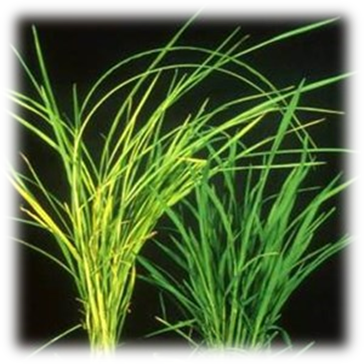
2. Bakaini (fungal)
Infected plants are few inches taller, thinner and slenderer than normal plants. They are yellowish green in color with pale green leaves. Infected seedlings have lesions on roots.
Control:
- Azoxystrobin + Tebuconazole 50% 100ml
- Trifloxystrobin + Tebuconazole 75% 65 gram
- Azoxystrobin + Difenaconazole 32.5% 200ml
- Azoxystrobin + Propiconazole 32% 100ml
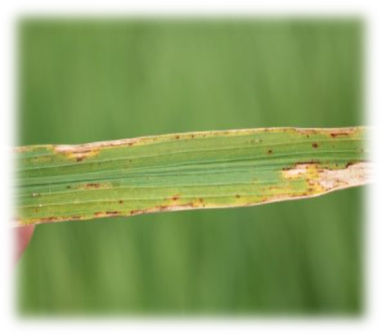
3. Bacterial blight of leaf
On seedling leaves, grey-green streaks appear at the tips and margins. These streaks turn yellowish-white with wavy edges after joining together and the leaves dry up, wilt and die. In older plants, the leaves display pale yellow marginal necrosis with wavy margins going from the tips towards the base, due to which plant dry up and die.
Control:
- Copper oxychloride + Kasugamycine 47% WP 250g (in 100 liter water)
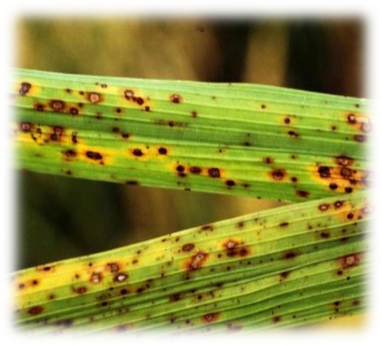
4. Brown leaf spots (fungal)
Small, brown or yellow brown lesions (necrotic spots) appear on the seedling leaves or coleoptile distorting leaf sheath. At tillering stage, lesions are initially small, circular, and dark brown to purple-brown. Fully developed lesions are circular to oval with a light brown to gray center, surrounded by a reddish brown margin caused by the toxin produced by the fungi.
Control:
- Azoxystrobin + Tebuconazole 50% 100ml
- Trifloxystrobin + Tebuconazole 75% 65 gram
- Azoxystrobin + Difenaconazole 32.5% 200ml
- Azoxystrobin + Propiconazole 32% 100ml
5. Stem Rot of Rice (fungal)
In water-sown rice, small, irregular black lesions appear on leaf sheaths at the water line during tillering stage. As the disease advances, infected sheaths die. The infection may penetrate the stem, causing tiller lodging or death.
Control:
- Azoxystrobin + Tebuconazole 50% 100ml
- Trifloxystrobin + Tebuconazole 75% 65 gram
- Azoxystrobin + Difenaconazole 32.5% 200ml
- Azoxystrobin + Propiconazole 32% 100ml

Insect/ Pest and their Management
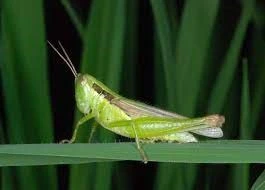
1. Grass hopper:
Grasshoppers feed on the leaves, shoots and sometimes cut the panicles. The grains of attacked inflorescence become chaffy.
CHEMICAL CONTROL:
- Bifenthrine @330ml.
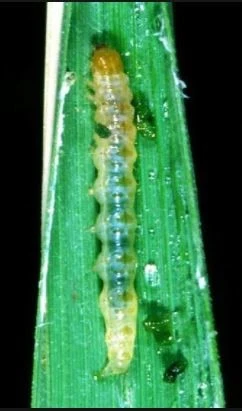
2. Rice Leaf-folder
The caterpillar folds the leaf longitudinally around themselves by attaching their margins together with silk strand. Inside the folded leaf, larvae create transparent or white streaks by scraping the green tissues of leaves. Rice field appear scorched.
CHEMICAL CONTROL:
- Thiamethoxam + Chlorantraniliprol 0.6% GR @ 4 kg/a (broadcast after 20 days of transplantation)
- Thiamethoxam + Chlorantraniliprol 40% WG @ 40 gm/a (spray after 40 days of transplantation)
- Broadcast Cartap hydrochloride 4 G @ 9 kg/a after 25 to 30 days (1st) and 50 to 60 days (2nd) of sowing
- Spray Lambda cyhalothrin 2.5% EC @ 250 ml/a
3. Stem borers
The larvae bore throughout the tiller, feeding upon the plant tissues during vegetative stage, causing "dead heart" or drying of central tiller. While at reproductive stage empty or whitish panicles emerge from attacked plants and this condition is known as "white head".
CHEMICAL CONTROL:
- Thiamethoxam + Chlorantraniliprol 0.6% GR @ 4 kg/a (broadcast after 20 days of transplantation)
- Thiamethoxam + Chlorantraniliprol 40% WG @ 40 gm/a (spray after 40 days of transplantation)
- Broadcast Cartap hydrochloride 4 G @ 9 kg/a after 25 to 30 days of sowing

4. White-backed plant hopper
Both adult and nymph suck sap from phloem leading to reduced vigor, stunted growth, yellowing of leaves and delayed grain formation. Affected plants produce seedless glumes (incomplete grains), and this condition is known as "red disease". In severe cases plant wilt and die, resulting in irregular "hopper burn" patches in the field.
CHEMICAL CONTROL:
- Spray Clothianidin 20% SC @ 150 to 200 ml/a
- Dinotefuran 30% @ 75 ml/a

Harvesting
- Crop should be harvested on time to attain maximize yield and grain quality.
- The optimum time for harvesting is when 80-85% grains are matured and grain moisture is between 20-22%.
- Moisture content should be reduced to 12-13% for storage, by exposing rice to sun for 4-6 hours.
- For mechanical harvesting rice harvester (kabota) should be used. An optimum speed of machine should be maintained to avoid losses. After harvesting machine should be cleaned properly to avoid mixing (impurity).
- If grain moisture content is below 18% at the time of harvesting, then mechanical harvesting should be avoided.







.webp)
