Land Preparation and Sowing Method
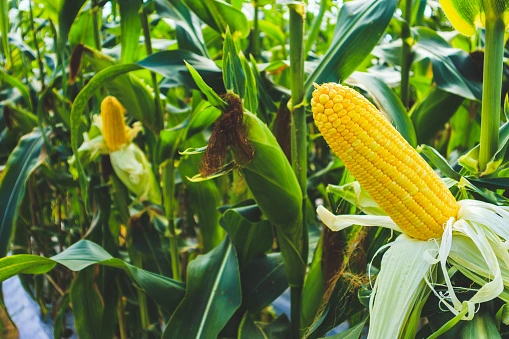
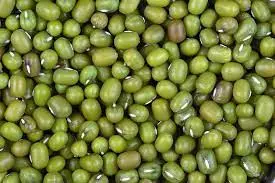
Maize is an important agricultural crop of Pakistan, used for many purposes (edible oil, glucose, custard, jelly and cornflakes) and is grown in many parts of the country. For the last few years, the production of this crop has increased significantly at the national level and especially in Punjab, due to which the financial condition of the farmers has improved significantly. Pulses are important source of human food and animal feed. It contains 25 – 30% protein and is cultivated on 5% of total cropped area. Pulses play an important role in sustaining soil fertility by fixing atmospheric nitrogen and improving soil physical properties. Being drought resistant crops, mung and mash bean are suitable for dryland farming and can be intercropped with other crops. Beside protein, they are also a good source of carbohydrate and vitamins.
Land preparation
Well pulverized land with adequate moisture supply is a pre-requisite for pulses production. Mung bean and mash bean can be cultivated in wide range of soil except saline and water-logged soils. Loamy to sandy loam soils are best for its production. Residues from previous crop should be mixed in the soil with the help of disc harrow or rotavator. Besides, land should be leveled using laser land leveler for even irrigation. Plough the land before rauni irrigation (or before rainfall in barani areas). After that 2 cultivation followed by land leveling is necessary to achieve better soil tilth.
Sowing time:
Spring Maize: (Suitable time of cultivation) can be cultivated from the end of January to the end of February.
In Rawalpindi and other hilly areas, the best sowing time of spring maize is from 15th March to 15th April.
Seasonal Maize: Mid-July to mid-August is the best time for seasonal cultivation of maize.
Seed rate:
Seeds should be clean, healthy, pure and have more than 90% germination. Keep seed rate of 8 to 10 per acre. Whereas for sowing by single row cotton drill (only in rainfed areas) use seed rate of 12 to 15 kg per acre.
Plant population/ acre:
The number of plants of hybrid varieties should be 33-35 thousand in spring crop and 30-32 thousand plants per acre in Kharif, while for synthetic varieties the number of plants in spring crop should be 30 thousand and in Kharif 23-26 thousand per acre. Keep 6-8 inches plant to plant distance.
Note: Maize can also be grown on bed made at a distance of 3.5 feet, planted on both sides of the bed by choka method. In the case of cultivation on ridges, make at a distance of 2.5 feet from east to west and immediately after applying light irrigation. In the case of spring cultivation, put seed by choka method on the south side of the ridges and on the north side in Kharif cultivation.
Seed treatment:
Seed is treated with Azoxystrobin + Clothianidin 62.5% at 9 g per kg of seed or Azoxystrobin + Clothianidin + Fludioxonil 72% at 9 g per kg seed or Imidacloprid + Tebuconazole 37.25% per kg 10 ml per kg seed to prevent the attack of sucking insects, particularly the Shoot fly, and to protect the crop from disease attacks.
Approved Varieties in Pakistan
Synthetic Varieties: Malka-2016, Gohar-2019, Sahiwal gold, Smit Pak, Pearl, MMRI-Yellow, Pop-1, Sweet-1.
Hybrid Varieties:
| Spring cultivation | Seasonal cultivation |
|---|---|
| High corn-11plus | High corn-339 |
| DK-9108 | High corn-555 |
| YH-5427 | FH-1036 |
| HC-2090 | DK-8148 |
| DK-6724 | YH-5427 |
| DK-6103 | P-4040 |
| DK-6317 | 30T60 |
| 30Y87 |
Synthetic varieties and their best planting time:
| Areas | Varieties | Planting time |
|---|---|---|
| Bahawalnagar. Rahim Yar Khan, Bahawalpur, Multan, Faisalabad, Jhang, Chiniot, Okara, Sahiwal, Sarghodha, Mianwali, Narowal, Lahore, Sialkot, Gujranwala, Sheikhupur | Sahiwal-2002, MMRI – Yellow, Pearl, Sahiwal gold, Gohar-19 | 15 July to 10 August |
| Jhelum, Gujrat, Attock, Rawalpindi (Except Mountain areas) | Agaiti-2002, Sahiwal-2002, MMRI-Yellow, Pearl | Cultivate according to monsoon |
| Mountain regions of Rawalpindi | MMRI-Yellow, Pearl, Sahiwal-2002, Agaiti-2002 | 15 March to 15 April |
Fertilizer Management
In order to obtain a good yield of maize per acre and to determine the correct amount of recommended fertilizers, it is very important to conduct soil analysis. Growtech recommends farmers get their soil analyzed. So that better production can be achieved at lower cost. Before applying fertilizers, it is important to understand the growing stages of maize so that after conducting a soil analysis, the right fertilizer can be applied in the right amount at the right time.
The right fertilizer at the right time in the maize crop ensures maximum yield.
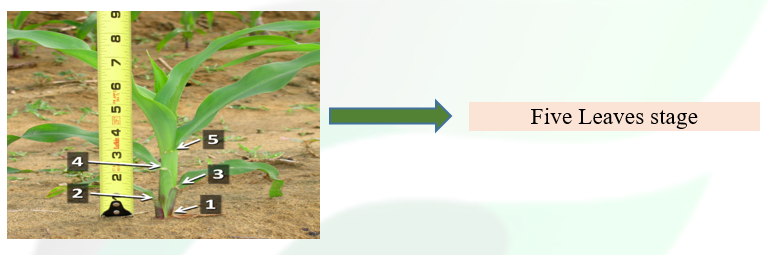
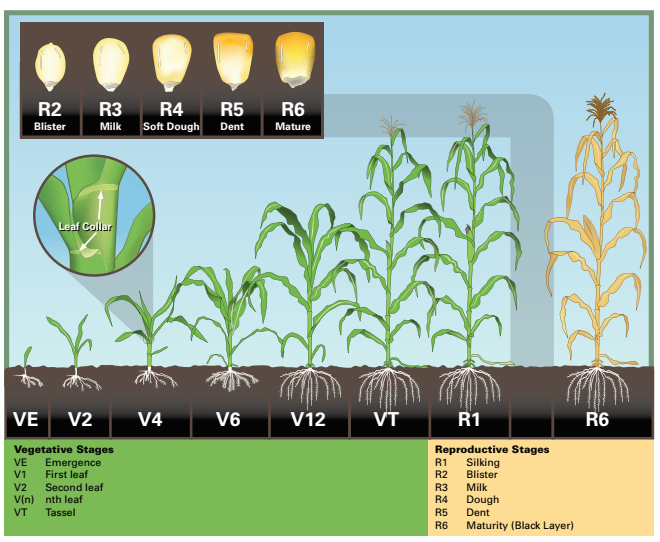
Table 5.1 Growth and development stages in corn. (adapted from Ritchie et al., 1993)
| Vegetative stages | Reproductive stages |
|---|---|
| VE: Emergence | R1: Silking- silks visible outside the husks |
| V1: First leaf collar | R2: Blister- kernels are white and resemble a blister in shape |
| V2: Second leaf collar | R3: Milk -kernels are yellow on the outside with a milky inner fluid |
| V3: Third leaf collar | R4: Dough- milky inner fluid thickens to a pasty consistency |
| V(n): Nth leaf collars visible | R5: Dent – nearly all kernels are denting |
| VT: Tasseling – last branch of tassel is completely visible | R6: Physiological maturity- the black abscission layer has formed |
Recommendations according to growth stages
| Stages | Factors | Recommendations |
|---|---|---|
| Emergence | Complete in 8-10 days(spring) Complete in 5-7 days(Autumn) |
Land preparation Use phosphorus fertilizer before sowing Seed treatment Weedicide application |
| 1-2 leaves stage | After 1 week of emergence Less root development Collar of the 1st true leaf (not the coleoptile leaf) is visible. Plant is still relying primarily on seed reserves for survival |
Adequate use of water and nutrient. |
| 3-4 leaves stage | After 2 weeks of emergence Plant height 20 cm |
Weedicide application Application of Granular chemical |
| 5-8 leaves stage | A time of vigorous growth Depending on its relative maturity, the maize plant determines the maximum number of rows around the ear between the V5 to V8 stage in its life cycle Formation of new leaves after every 3-4 days. Establishment of the number of kernel rows around the ear is a critical event and is susceptible to environmental stress. |
Sensitive stage about water and nutrient deficiency Best time of nitrogen application |
| 10-11 leaves stage | Rapid consumption of Nutrients Application of phosphorus and potassium • Two yield components – the potential number of kernels and the ear size – are being determined during the period from V10 to V17. |
Irrigation application Use of potash |
| 12-13 leaves stage | Rapid consumption of food No. of kernel rows set. Determination of no. of ovules begins. (no of grains). Large amount of N P K Utilized at this stage. Avoid drought and follow proper irrigation |
Adequate use of water and nutrient. |
| 14-15 leaves stage | This vegetative stage is the most critical period of kernel yield determination. The number of ovules that develop silks, and thus the number of kernels, is being determined. The tassel is near full size but not visible from the top of the leaf sheaths. Silks are just beginning to grow from the upper ears |
Adequate use of water and nutrient Application of last dose of nitrogen |
| 16-17 leaves stage | Cob and Tassel appearance | Adequate use of water and nutrient |
| Tasseling | 50-55 days after germination The growth phase has been completed. Cob length continues to increase. Number of lines & grains per kernel has been determined. The only function of the tassel is to produce enough pollen to fertilize the ovules in the female flower. Vigorous maize tassel can produce between 2-5 million pollen grains. |
Deficiency of water will affect pollination process- Continue proper irrigation. |
| Silking | Silking starts 3 days after tasseling Ready for pollination in 3-5 days- Pollination process continues for 10 days Silk grows 5-8 cm in a night- Silk grows till pollination |
Hot and dry weather leads to reduction in pollination Deficiency of water reduces production by 5-7% per day |
| Blister | After fertilization the silks wilt and turn brown. 10 days after fertilization, developing kernels appear as watery blisters on the cob called the blister stage or R2. The cob has reached its full length and diameter. Within the next 2 weeks the kernels grow very rapidly, and the developing embryo takes shape within them. At this stage most of the plant's physiological activity is directed toward filling the kernels |
Continue irrigation at proper intervals |
| Milking | Started 20 days after pollination, Kernels are yellow and milky sugar bodies. This is the 'roasting ear', or milk stage (R3) If severe stress occurs during these early reproductive stages the kernels may be aborted from the tip down, to lessen the load on the plant. |
Continue irrigation at proper intervals |
| Dough Stage | Started 3 weeks after silking and continues for 2 weeks. Sugars continue to pour into the kernel as before, but they are rapidly converted to starch, first in the form of sticky, gummy dextrin's, and shortly afterwards into drier starch. Starch is composed of sugar molecules joined together in long chains with the help of starch-forming enzymes. |
|
| Dent | Started 40 days after fertilization. Milk line appears The amount of dry matter in the kernel is increasing. In the soft dough stage, about 55% and in the hard dough stage more than 90% are dented. By the end of the seventh week of kernel development, Embryo has nearly reached its full size, filling has begun to slow, and the kernel is approaching maturity. |
Continue irrigation at proper intervals Last irrigation |
| Physiological Maturity | After 50-60 days of fertilization this stage comes. Physiological maturity also referred to as Black Layer • Black layer stage occurs when the starch line has progressed to the base of the kernel. This can be identified by slicing the kernel and observing the black line that occurs at the kernel base. Maximum dry matter has now accumulated in the kernel. • Moisture content is approximately 30 to 35 percent at black layer formation. |
Stage wise fertilizer recommendation for one acre:
| Time of Application | Phosphorus | Nitrogen | Potash | Organic fertilizer | Zinc | Boron |
|---|---|---|---|---|---|---|
| At time of Sowing | 2 Bag DAP + 2 Bags BOP | Borax (11% boron) 3 kg | ||||
| At 3-4 leave stage | 1 Bag Urea | 10liter potassium humate | ||||
| At 5-6 leave stage | 1 Bag Urea | 10 liter Zinc sulphate | ||||
| At 8-10 leave stage | 25kg Urea + 1Bag Ammonium Sulphate | 10 liter Potash 30% | ||||
| At 12-14 leave stage | 25kg urea | 12.5 kg Potassium sulphate |
Note: The Above mentioned recommendations are for Average soils. Growtech recommend fertilizer after soil analysis. Use less than 25% nitrogen, 25% phosphorus and 50% potash for silage crop. Harvest crop 85-90 days after sowing for silage purpose.
Irrigation
Keep the maize grown on ridges in wet condition till germination, and apply first six irrigations at 5 to 7 day intervals, then reduce the irrigation interval according to weather conditions and crop requirements. Do not allow the crop to dry out during the flowering stage and the milky stage of the grain, as the shortage of water at these stages will adversely affects the yield. A spring maize crop usually requires 12 to 14 irrigations. Since seasonal maize is sown in hot weather, keep the irrigation interval short in the early stages of the crop and reduce irrigation as the temperature drops. Extend the interval. Seasonal i.e. Kharif maize requires 10-12 irrigations.
Note: Depending on the soil texture and weather conditions, the timing of irrigation may be varied.
Weeds Management
| Weeds | Chemical Name | Time of application | Dose per acre | Method of application |
|---|---|---|---|---|
| Broad leaves | Pendimethalin 33% | Before emergence | 1000ml | Spray within 24 hours after sowing |
| Broad and Narrow leaves | Atrazine 38% + Acetochlor 50% | Before emergence | 350 ml +350 ml | Spray within 24 hours after sowing |
| Broad and Narrow leaves | S-metolachlor+ Atrazine 72% | Before emergence | 800ml | Spray within 24 hours after sowing |
| Broad and Narrow leaves | Atrazine + Mesotrione + Propisochlor 33.5% | After emergence | 750ml | 2 to 4 leaf stage of weeds |
| Broad and Narrow leaves | Atrazine + Mesotrione 50% | After emergence | 330 to 400g | 2 to 4 leaf stage of weeds |
| Broad and Narrow leaves | Atrazine + Mesotrione 55% | After emergence | 500-750ml | 2 to 4 leaf stage of weeds |
| Broad and Narrow leaves | Atrazine + Mesotrione 25% | After emergence | 650ml | 2 to 4 leaf stage of weeds |
| Broad, Narrow leave and sedges | Atrazine + Mesotrione +Halosulfuron 58% | After emergence | 500g | 2 to 4 leaf stage of weeds |
Important instructions regarding chemical use:
- Never use weeds as fodder after spraying. Apply herbicides to spring corn after weeds emerge. Maintain 120 liters of water per acre. Use clean water to spray.
- Do not spray in strong wind, rain or fog.
- Use a (flat fan or T-Jet) nozzle for a standard spray.
Diseases and Their Management
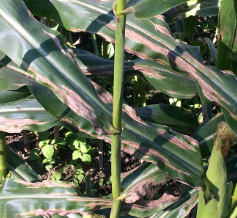
1. Leaf Blight of Maize:
Symptoms
At the beginning of the infestation small, longish, watery stains arise which can grow into elongated bands of grey-green to light brown lesions. It can spread up to six inches lengthwise over the leaves.
Control measures
To prevent this disease, apply thiophenate methyl 70 WP at the rate of 2 grams per kg of seed before sowing.
2. Ear and Grain Rot:
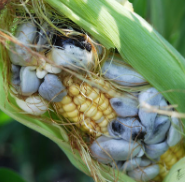
Symptoms
White to pink or salmon-colored, cottony mold that occurs on single or multiple kernels scattered or clustered on the ear. Decay often begins with insect-damaged kernels. Infected kernels are frequently tan or brown or have white streaks.
Control measures
Do not use excessive nitrogen fertilizers to prevent this disease.

3. Smut of Maize:
Symptoms
Galls (abnormal growths) can appear anytime throughout the growing season on any above ground plant part. Young, actively growing tissue is especially susceptible. Galls commonly develop on ears tissue.
Control measures
To prevent this, apply Benomyl 50 WP at the rate of 2 grams per kg of seed before sowing.
4. Stalk rot:
Symptoms
Stalk rot symptoms appear several weeks after silking. Leaves of infected plants wilt, become dry and appear greyish-green. Lower internodes become brown and spongy. Small, black fruiting bodies (pycnidia) cluster near the nodes of the rind.
Control measures
To prevent this disease, apply Topsin M 70 WP at the rate of 2 grams per kilogram of seed before sowing. Flooding of Thiophenate methyl 1 kg or Fosetyl- aluminum 1 kg per acre as curative control will produce satisfactory results.
Insects / Pests and Their Management
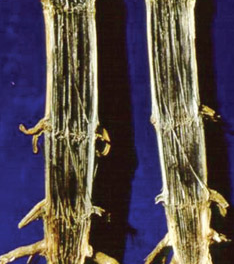
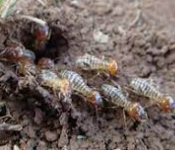
Termites:
Symptoms:
Partial or total defoliation of maize seedlings but are principally damaging to maturing or mature maize plants. Wilting, drying up, and lodging of plants when the termites attack the main root system, prop roots and stems.
Control:
To manage this, use Chlorpyrifos at the rate of 1.5 to 2 liters or FipronIl 5 SC at the rate of 960 ml per acre at the time of first irrigation or when the attack observed.
Shoot fly:
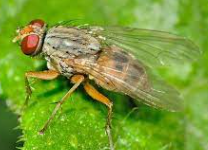
Symptoms:
Central shoot withering leading to "dead heart" is the typical damage. Bore holes are visible on the stem near the nodes. Young larva crawls and feeds on tender folded leaves causing typical "shot hole". Affected parts of stem may show internally tunnelling caterpillars.
Control:
The crop is protected from the attack of this bee for 40 days before sowing by applying Thiamethoxam 70 WS at the rate of 5 to 7 g/kg seed. In case of attack after germination, spray Imidacloprid 200 SL at the rate of 200 ml in 100 liters of water per acre. Or Use Carbosulfan +emamectin benzoate 25% 200 ml per acre. Or Clothianidin 20% 200 ml per acre. Spray Lambda cyhalothrin 2.5% EC @ 250 ml/acre Or Bifenthrine 10 EC @ 250 ml/acre
Stem borer:
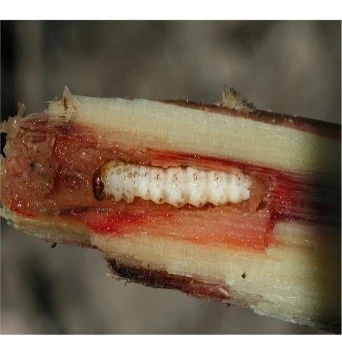
Symptoms:
The first indication of damage is the appearance of small "windows" on the youngest whorl leaves. These symptoms result from larval feeding on the upper surface of the leaf, leaving the lower surface intact. As larvae grow, holes in the leaves become bigger until large numbers of holes appear (illustrated) or leaves take on a ragged appearance. When infestation takes place at early plant growth stages, plants may develop dead heart symptoms. When infestation occurs at later growth stages, typical whorl damage symptoms appear. Infestation at late plant growth stages may result in larval damage to maize ears (illustrated) and when larvae bore into stalks, stalk breakage can occur during strong winds. The maize stem borer is a chronic pest that can cause serious damage if it is not controlled.
Control:
To prevent this, use carbofuran 3 G at 8 kg per acre and irrigate the field. After 15 days repeat the process. As a protective measure, add granulated chemicals such as fipronil 0.3% G at 8 kg or Chlorantraniliprole + Thiamethoxam 0.6% G at 4 kg per acre of and repeat the process as needed. Note: Granules will be applied via whorl application.
Jassid:
Symptoms
Corn aphids can invade crops at any time between seedling stage and grain fill. Early infestations can cause reduced tillering, stunting and early leaf senescence. Later infestations on leaf sheaths and flag leaves between booting and the milky dough stages can also result in yield losses. Secretion of honeydew can cause secondary fungal growth, which inhibits photosynthesis and can decrease plant growth.
Control:
In case of attack, spray Dinotefuran 30% at 75 ml per acre. or Imidacloprid at 200 ml per acre

Aphid:
Symptoms:
Aphids are feeding and causing direct damage. Heavily infested plants may turn yellow and may be covered in a sugary honeydew produced by the aphids and on which black sooty moulds may develop.
Control:
To remedy this, spray Carbosulfan 120 EC at the rate of 500 ml per acre in 100 liters of water. Or Imidacloprid 200SL at 200-250 ml per acre.

Army worm:
Symptoms:
Armyworm feeding gives corn a ragged appearance, with defoliation occurring from the leaf edge toward the midrib. Damage may be so extensive that most of the plant, except leaf midribs and the stalk, is consumed. Such a highly damaged plant may recover, however, if the growing point has not been destroyed.
Control:
Use lufenuron 5% 200 ml per acre Or Bifenthrin 10% +lufenuron 5% 400+200 ml per acre Or Lufenuron +Emamectin 3% 400 ml per acre
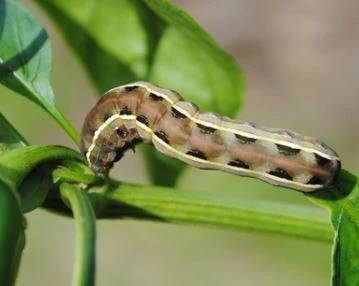
Fall Army worm:
Symptoms:
They eat the tissue of the leaves, leaving holes behind as a characteristic sign of this insect. Normally, one or two larvae feed in a whorl, as larger larvae can feed on younger larvae to reduce competition. Unlike the normal army worm, it also eats the stem and cob and causes severe loss of production. It attack is high on the 30 to 40 day crop and it damages the maize crop by 30 to 35 percent.
Control:
Flomect 5% EC @ 70 ml (in 20 liter water)
Harvesting
Understand that the crop is physiologically mature and ready for harvest when the inner peels of the cobs dry, the grains become shiny and firm, the nails in the grains cannot be pierced, and if grains are detached from the cob, their pointy ends are black or brown. Grain moisture at that time ranges from roughly 30% to 35%. At this point, the crop should be harvested. Maize yield diminishes if it is harvested before the aforementioned signs, i.e., while it is still green and immature, show. Its germination is also affected if it is utilized as a seed. Similarly, if the crop is not harvested on time after ripening, there is a possibility of damage due to crop fall and bird eating. If it rains after the crop falls, the grain gets damaged due to fungi. After harvesting, take out the cob from the husk and spread them in open places, and when the kernels break with a crackling sound when pressed with the teeth, know that the grains are dry. At this time the moisture content of the grains is about 15%, the moisture content should be 10% for storage purposes.






.webp)
