Land Preparation and Sowing Method
Sugarcane is an important industrial and cash crop in Pakistan. It is mainly grown for sugar and sugary production. It is an important source of income and employment for the farming community of the country and also forms essential items for industries like sugar, chip board, paper, barrages, confectionery, uses in chemicals, plastics, paints, synthetics, fiber, insecticides and detergents. Average production of sugar cane in Pakistan is 450 - 500 mounds per acre which is very much low compared to the cane production by other countries. Agronomic factors like preparatory tillage (2-3 ploughings and 1 planking), bed preparation, planting techniques and planting time, water and fertilizer availability, management of ratoon crop, harvesting time, type of cultivars and plant protection measures significantly affect its production. These all factors also contribute to the cost of production.
Reasons of low productivity:
- Agricultural Factors;
- Improper selection of land
- Improper preparation of land
- Conventional planting methods
- Late planting
- Moisture stress at critical stages of crop growth
- Poor management of ratoon crop
- Early and late harvesting
- Low soil fertility
- Defective varieties
- Pests, disease and weeds
- Credit shortage
- Rapid/Unplanned increase in sugarcane acreage in unsuitable areas of Pakistan.
It is remarkable that cultivation of sugar cane crop is carried out for crushing purpose to obtain sugar, gur (Jaggery) and other products. By-products like alcohol used in pharmaceutical industry, ethanol used as fuel, bagasse used for paper making and chipboard manufacturing and press mud used as a rich source of organic matter that adds to soil fertility are derived after cane is crushed.
Land Preparation:
Sugarcane is a tap-rooted crop and proper land preparation plays an important role in the development of cane root system, which helps to achieve the optimum growth & Development. Deep plowing should be practiced before sowing to break the hardpan of soil. The purpose of deep plowing is to modify the soil water retention characteristics over the long term Land should be prepared by deep ploughing at least after every two years. The soil should be disked, six to eight subsequent ploughings followed by planking are enough to achieve a good pulverized seedbed free of clods and weeds.
Time of Sowing:
Spring sowing: 15th February to End of March
September sowing: 1st September to 15th October.
Row to Row Distance: Row spacing is ranges from 60-120 cm.
Sowing Depth: Sow the sugarcane sets at a depth of 3-4 cm and cover it with soil.
Method of sowing:
For sowing use improved method of planting like deep furrow, trench method, paired row method or ring pit method
1. Dry planting in ridges and furrow:
Row to row spacing 15 cm. With the help of tractor drawn ridger, make ridges and furrows at distance of 90 cm. Plant sugarcane setts then cover it with soil. After then give light irrigation.
2. Paired row planting:
Make Trenches at 150 cm distance using trenches opener. Plant sugarcane in paired row using 30:30-90-30:30 cm spacing. It gives higher yield as compared to ridges and furrow.
3. Ring Pit method:
Circular pits of 60 cm diameters are dug at depth of 30 cm with a tractor mounted digger. 60 cm gap is provided between adjacent pits. 2-3 ratoons can be taken. 25-50% higher yield can be obtained compared to ridge and furrow.
4. Single budded set planting:
Select healthy setts for plantation. Make furrows at distance of 75-90 cm. Place single budded setts. If only small size setts from top portion of cane are selected then they are planted at distance of 6"-9". Place eye of sett on upward direction to ensure proper and quick germination. Cover setts with soil and apply light irrigation.
Seed Rate:
- 30 thousand sets /acre (2 buded)
- 20 thousand sets/acre (3 buded)
Note: An average yield of about 800 to 1000 mounds per acre can be obtained from this seed rate.
Seed Treatment:
The sets should be soaked in Thiophenate methyl (70% WP) solution 5 minutes before crop sowing. To prepare this seed treatment solution mix Thiophenate methyle @ 3gram in 1 liter of water.
Approved Varieties of Sugarcane
Use healthy seed of improved & certified varieties of sugarcane. This can increase cane yield from 20 to 25 percent. Sugarcane varieties recommended for various provinces are given below. Recommended Varieties of Sugarcane
Punjab: CP 77-400, CP 72-2086, CP 43-33, CPF-237, HSF 240, SPF-213, SPSG-26, SPF 243, SPF 237, CPF 237, COJ-84.
Sindh: BL-4, BF 129, HS 2, Thatta - 10, PR-1000, CP 72–2086, L−113, L−116, NIA 98, SPSG 26, HS 4, HS 12, L-126, CP-43-33, NIA-2004, NIA-2010, NIA-2011.
K.P.K: MCP 421, CP 5121, JN 88 -1, Mardan 93, ABID 96, SPSG 344, CP 77-400, CP 44 -101, L 6296, SL - 98, Mardan - 92, Banu - 1.
| Sr.No | Variety name | Average yield (t/ha) | Sugar Recovery (%) | Sugar Yield (t/ha) | Sowing Time | Areas | Salient Features |
|---|---|---|---|---|---|---|---|
| 1 | CP43-33 | 80 | 11.69 | 9.35 | 1. September sowing February sowing |
Whole Punjab | Medium maturing, good yielding, good recovery, resistant to insect pest |
| 2 | CP72-2086 | 85 | 12.35 | 10.49 | 1.September sowing 2.February sowing |
Whole Punjab | Medium maturing, good field performance, good recovery with chewing quality, better for gur production |
| 3 | CP77-400 | 90 | 11.90 | 10.72 | 1. September sowing 2. February sowing |
Whole Punjab | Early maturing, good growth, better ratooning, Resistant to diseases |
| 4 | CoJ-84 | 90 | 9.80 | 8.82 | 1.September sowing February sowing |
Whole Punjab | Removed/ banned |
| 5 | SPF-213 | 90 | 10.50 | 9.45 | 1.September sowing 2.February sowing |
Whole Punjab | Medium maturing, good growth, average ratooning, slight lodging |
| 6 | CPF-237 | 95 | 12.50 | 11.87 | 1.September sowing 2.February sowing |
Whole Punjab | Early maturing, Good yielder, average ratooning, disease resistant behavior, non lodging in nature |
| 7 | HSF-240 | 95 | 11.70 | 11.11 | 1.September sowing 2.February sowing |
Whole Punjab | Medium maturing, frost and Red Rot Resistant, non-lodging |
| 8 | SPF-234 | 100 | 11.60 | 11.60 | 1.September sowing 2.February sowing |
Southern Punjab only other than riverine areas | Medium maturing |
| 9 | SPF-245 | 100 | 11.00 | 11.00 | 1.September sowing 2.February sowing |
Whole Punjab | Non lodging, good growth behavior, medium maturing, also fit for average input conditions |
Banned Varieties of Sugarcane
| Sr. No. | Variety name | Av. Yield (t/ha) | Sugar recovery (%) | Sugar yield (t/ha) | Sowing Time | Recommended Areas | Salient Features |
|---|---|---|---|---|---|---|---|
| 1 | CoL-29 | 70 | 10.10 | 7.07 | i. September sowing ii. February sowing |
Whole Punjab | Removed/ banned |
| 2 | CoL-44 | 75 | 8.93 | 6.69 | i. September sowing ii. February sowing |
Whole Punjab | Removed/ banned |
| 3 | CoL-54 | 75 | 9.63 | 7.22 | i. September sowing ii. February sowing |
Whole Punjab | Removed/ banned |
| 4 | BL-19 | 85 | 9.49 | 8.00 | i. September sowing ii. February sowing |
Whole Punjab | Removed/ banned |
| 5 | BL-4 | 85 | 10.34 | 8.79 | i. September sowing ii. February sowing |
Whole Punjab | Removed/ banned |
Earthing Up in Sugarcane:
Earthing up is a practice followed to prevent lodging. Sugarcane usually lodges in August - September. It may even lodge in July if the cane crop is much healthier. Lodged cane caused losses e.g. reduction in yield, increases damage of mice, buds start germination, reduction in sugar recovery and hurdle in loading etc. lodged crop also become victim of frost and cannot be used as seed for next crop. Crop lodging might be due to many reason, i.e., cane variety, sowing. Earthing up is done at maximum tillering stage.
Fertilizer Management
Sugarcane is an exhaustive crop like wheat, rice, maize etc, that uptake huge amount of nutrients. Balanced and optimum use of fertilizer will results profitable production. For fertilizer calculation soil analysis plays key role. GROWTECH recommends crop-specific fertilizer application based upon the soil available carbon, nitrogen and fertility status in balanced amount to achieve better crop growth and 15-20% higher yield.
- Following the recommendation for average fertile soils for one acre.
(Average type soil contains 0.86% to 1.29 % organic matter, 7 to 14 ppm phosphorous, 80 to 180 ppm potash).
| Time of application | Posphorus | Nitrogen | Potash | Organic matter | Zinc |
|---|---|---|---|---|---|
| At sowing time (land preparation) | 1.5 bag of Diammonium phosphate (DAP) + 2 bag Bioorganic phosphate (BOP) OR 2.5 bags of (DAP) | ||||
| 45 days after sowing | 1 bag urea | 8 kg zinc sulphate (27%) or 10 litter zinc (10%) | |||
| 75 days after sowing | 1 bag urea | 10 litter potassium humate | |||
| 100 days after sowing | 25 kg urea | 10 litter potash (30 %) Or 12.5 kg potassium sulfate (50 %) | |||
| 140 days after sowing | 25 kg urea | 12.5 kg potassium sulfate Or 10 litter potash (30%) | |||
| 180 days after sowing | 1 bag urea | ||||
| 210 days after sowing | 1 bag urea |
Note: In case of Ratoon crop use of nitrogenous fertilizers should be increased by 25-30%.
Irrigation
The number of irrigations required will depending upon soil type, water availability etc. The hot weather associated with dry winds and drought increases the water requirement of the crop.
- Apply first irrigation when 20-25% crop has been germinated.
- In monsoon, apply irrigation depending upon rainfall intensity and frequency.
- In case of scanty rainfall apply irrigation with 10 days interval. Afterwards increase irrigation intervals, i.e apply water with 20-25days interval.
- To conserve moisture in soil do mulching in between cane rows.
- Avoid water stress from April to June.
- Water stress during these days will reduce yield. Avoid water logging in standing field
- Tillering stage, stem elongation and grand growth phases are most sensitive stages towards irrigation.
| Month | Number of Irrigations | Irrigation Interval |
|---|---|---|
| March – April | 2-3 | 20-30 days |
| May- June | 5-6 | 10- 12 days |
| July-August | 3-4 | 15-20 days |
| Sep- Oct | 2-3 | 20-30 days |
| November-February | 4 | 30 days |
| Total Number of Irrigations | 16-20 |
Weeds Management
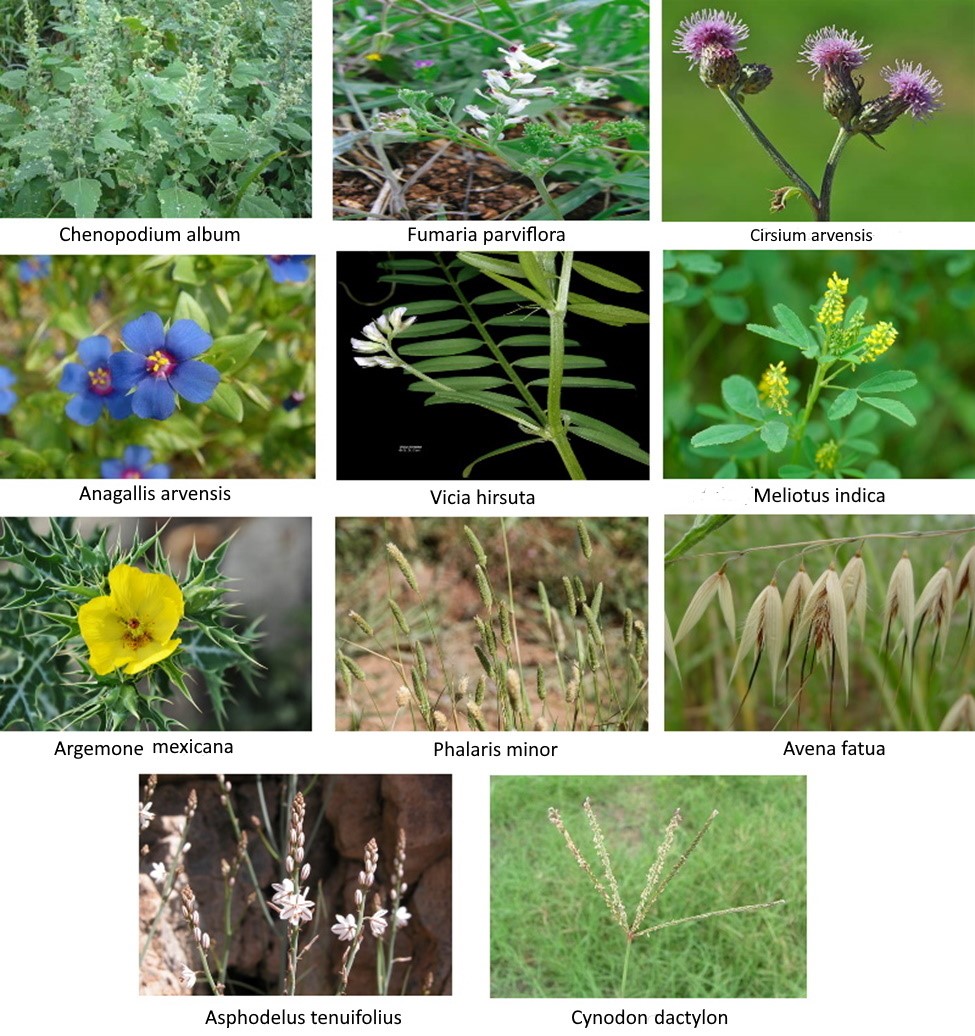
In sugarcane due to weed infestation about 12 to 72% yield loss is observed depending upon severity. Initial 60-120 days are critical for weed management. Therefore, weed management practices should be adopt within 3-4 months after planting. For control of weeds, chemical is not only solution. Adopting mechanical as well as cultural practices gives effective solution.
Mode of Damage
- Competition for Nutrients
- Competition for moisture
- Competition for light
- Competition for space (CO2)
- Allelopathic Effect
- Serve as reservoirs of pests and diseases
Mechanical Measure: As sugarcane is widely space crop, weeding with hand or interculture operation can be easily carried out. Take 3-4 hoeing after every irrigation.
Cultural Operations: It included change in cropping pattern, intercropping and trash mulching. Mono cropping leads to heavy infestation of weed. Crop rotation with fodder or green manure crops suppress weeds. Also sugarcane is wider space crop so there is opportunity for weed to grow in large numbers. If sugarcane is intercrop with short duration crops then it will suppress the weed growth also give additional benefit. In trash mulching, mulch of 10-12cm thickness is provided in between cane row after emergence of cane. It will restrict the sunlight thus help to check weed growth. It also conserved soil moisture.
Chemical Control:
| Type of Weeds | Chemical | Time of Application | Dose/ Acre | Method of application |
|---|---|---|---|---|
| Broad Leave Weeds | S-Metolachlore (96%) | Pre emergence | @800 ml | Spray or flood within 24 hours after sowing |
| Broad & Narrow leaves | Atrazine(38%)+ Acetochlor(50%) | Pre emergence | @500ml +500ml | Spray within 24 hours after sowing |
| Broad & Narrow leaves | Atrazine+ Mesotrione+ Propisochlor(33.5%) | Post emergence | @1500 ml | Use at 2- 3 leaf stage of weeds |
| Broad & Narrow leaves+ Deela | Atrazine+ Mesotrione+ Halosulfuran(58%) | Post emergence | @1000 gram | Use at 2- 3 leaf stage of weeds |
Important instructions:
- Never use weeds as fodder after spraying.
- Do not spray in strong wind, rain or fog. Use clean water to spray.
- Use a (flat fan or T-Jet) nozzle as a standard practice for spraying.
- For better management of weeds in sugarcane, use 120 – 160 liters of water per acre.
- Spraying is advised to be followed after calibration of machine.
Sugarcane Diseases and their Management
Red rot:
Symptoms:
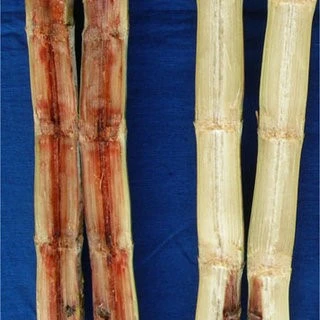
This disease is caused by a fungus, Cholletotricum falcatum.
Yellowing of upper leaves.
Leaves start drying from bottom to top.
If fungal spores enter the leaf sheath through the leaf midrib, reddish patches appear on the back side of the leaf midrib.
When the damaged cane is split open, the inner portion is reddish with intermittent white tinges running the length of the cane.
Control measure:
Thiophanate-methyl 70% (2 kg per acre) Or Copper oxychloride 50% (2 kg per acre) Or Fosetyl aluminum 80% (1.5 to 2 kg per acre)
Method of application:
Seed treatment or Flood with first irrigation as a preventive measure Flood with first irrigation as a preventive measure Flood second application before monsoon rains
Whip smut:
Symptoms:
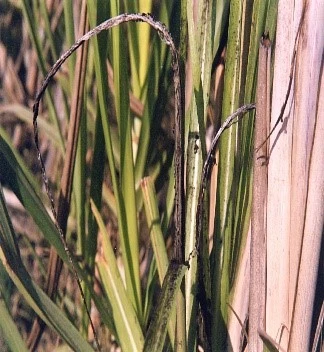
This disease is caused by a fungus, Ustilago scitamineae.
Sugarcane smut is easily recognized by the black whip-like structure that forms from the growing point of the sugarcane plant.
Whip covered by translucent silvery membrane enclosing mass of black powdery spores
Control measure:
Remove the infected plants from field. Avoid keeping infected crop as ratoon.
Pokkah Boeng:
Symptoms:
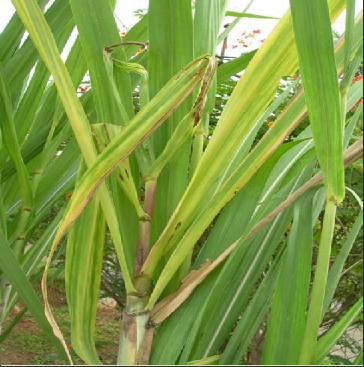
This disease is caused by a fungus, Fusarium moniliforme.
The earliest symptom of pokkah boeng is a chlorotic condition towards the base of the young leaves and occasionally on the other parts of the leaf blades.
The most advanced and serious stage of pokkah boeng is a top rot phase. The young spindles are killed and the entire top dies
Red Stripe:
Symptoms:
This disease is caused by a bacteris, Xanthomonas rubrilinians
Symptoms first appear on young shoots of which the growing points show dark-red stripes with water-soaked appearance followed by their rotting. The disease precedes downwards later on infecting terminal buds and the leaves.
The infected leaves show water- soaked elongated streaks turning chlorotic and carrying dark-red stripes about 0.5-1.0 mm in width and 5.0-100 mm in length. Usually the stripes coalesce to form larger bands. However, the lower half of the infected leaf shows more symptoms than the upper half.
Control measure:
Copper oxychloride + kasugamycin 47% (250 g per acre)
Method of application:
Spray
Rust:
Symptoms:
This disease is caused by a bacteris, Xanthomonas rubrilinians
Symptoms first appear on young shoots of which the growing points show dark-red stripes with water-soaked appearance followed by their rotting. The disease precedes downwards later on infecting terminal buds and the leaves.
The infected leaves show water- soaked elongated streaks turning chlorotic and carrying dark-red stripes about 0.5-1.0 mm in width and 5.0-100 mm in length. Usually the stripes coalesce to form larger bands. However, the lower half of the infected leaf shows more symptoms than the upper half.
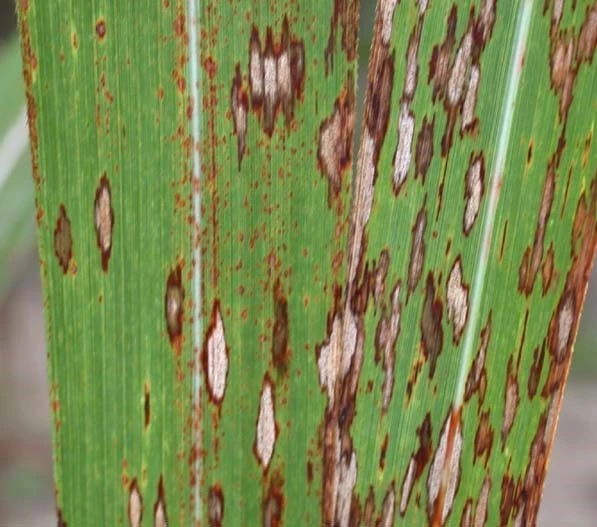
Puccinia melanocephala is the causal agent of this diseases.
The earliest symptoms are small, elongated yellowish spots that are visible on both leaf surfaces. The spots increase in length, turn brown to orange-brown or red-brown in color, and develop a slight, but definite, chlorotic halo.
Control measure:
Azoxystrobin +Tebuconazole 50% (100 ml per acre)
Method of application:
Spray if the crop at initial stages. Spray on the borders if the crop at Grand growth stages.

White Leaf Diseases:
Symptoms:
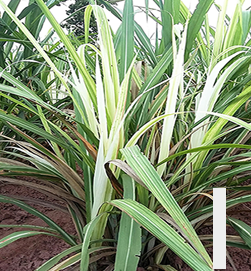
This is an insect-borne disease.
White line that runs vertically down the middle of the leaf blades.
Parallel to the initial line, white or yellow lines appear, eventually covering the entire leaf length.
The change of green to white leaves is the total loss of cholorosis.
Note: Two preventive fungicide applications (one immediately after sowing and the other before monsoon rains) are mandatory for control of Red Rot disease in sugarcane.
Insect/ pest and their Management
Termites:
Damage:
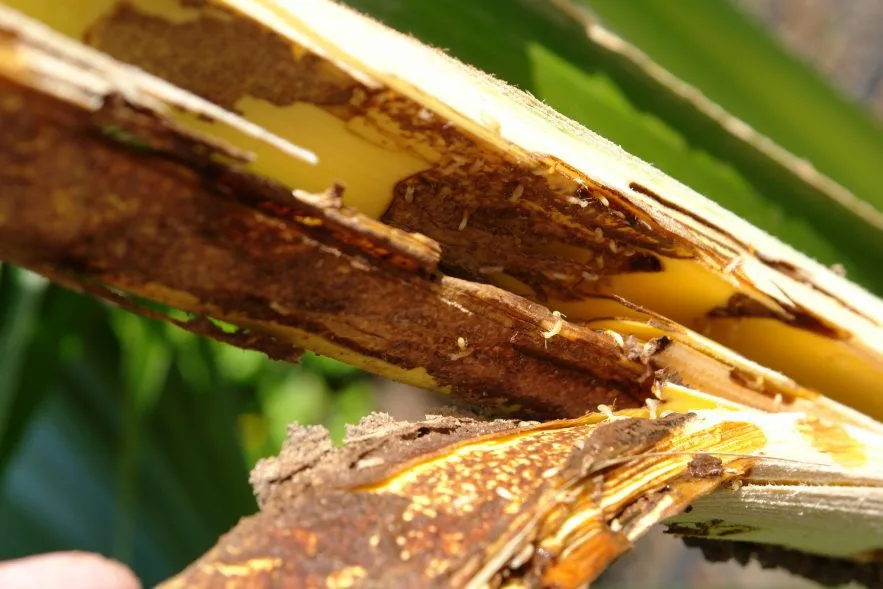
They enter into the setts either into the cut ends or eye buds and destroy the whole setts. If plants are attacked at the early stage, they feed on roots and inside the stem. As a result, the seedlings may die. If the seedlings do not die, it becomes very weak with discolored foliage and little growth of roots developed.
Control:
Fipronil 0.4 % G (12 kg per acre) basal application in lines at the time of sowing Or Carbofuran 3 % g (16 kg per acre) basal application in lines at the time of sowing Fipronil + Emamectin 0.35 % (8 kg per acre) basal application in lines at the time of sowing
Black bug:
Damage:
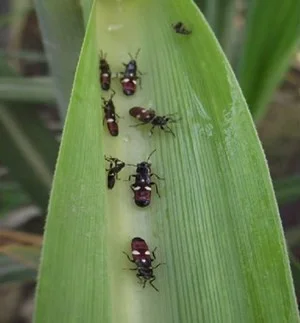
It causes harm on the ratoon crop. During the months of April and May, the crop is attacked during its first growth. Adults and larvae sucks leaf sap while remaining within the leaf cover. The damaged crop becomes yellow and develops dark red blotches on the leaves. Production is declining. Its main target is the drought.
Control:
Imidacloprid + Fipronil WG 80% (60 g per acre) spray.
Sugarcane Pyrilla:
Damage:
It sucks phloem sap from leaves and excretes honeydew onto foliage, which results in fungal diseases. This damages sugar yield and quality both directly and indirectly. The active stages of the life cycles favor the underside of the leaf blades, particularly near midrib as resting and feeding sites.
Control:
Chlorpyrifos 40 % (2 litter per acre) flood.

Sugarcane White fly:
Damage:
Larvae damage by sucking sap from the leaves. In case of severe attack, the leaves turn yellow and dry and the growth of plants stops. Sometimes they dry up and begin to wilt.
Control:
Chlorpyrifos 40 % (2 litter per acre) flood with irrigation. Or Acetamiprid (250 g per acre ) spray
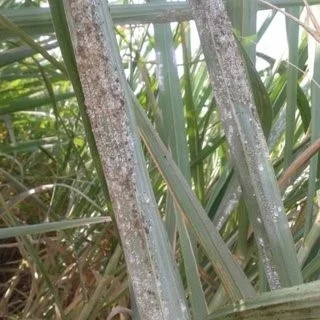
Red mites:
Damage:
Larvae and adults suck the sap of the leaves. The color of the leaves turns brownish-red. May to July the attack is severe in hot dry weather. Initially the attack usually takes place in patches and later they infest the crop very quickly.
Control:
Abamectin 1.8% (400 ml per acre) spray

White mites:
Damage:
These mites form white webs on the lower surface of the leaves. White spots are seen in successive parallel rows on the leaves. Mites are very hardy. The attack is severe in August-September.
Control:
Abamectin 1.8% (400 ml per acre) spray

Sugarcane Pink mealybug:
Damage:
Sugarcane mealybug is mostly on top of the knots under the leaf. From where it sucks the sap of the leaves and stem and causes damage. If the attack becomes severe, the leaves begin to dry up and the crop appears to have withered.
Control:
Clothianidin (200 ml per acre) spray Or Profenofos (50 ml in 20 litter water) spray

Initial stem borer:
Damage:
Female lays white eggs in the form of bunches on the inner surface of the leaves of small plants. From which the larvae hatch and make a tunnel by making a hole in the stem and cut the growing branch and dry it from inside. This insect causes more damage to the spring crop of sugarcane and completely destroys it by attacking the initial stem.
Control:
Fipronil 0.4 % (12 kg per acre) kera in lines at the time of sowing Or Carbofuran 3 % (16 kg per acre) kera in lines at the time of sowing Fipronil + Emamectin 0.35 % (8 kg per acre) kera in lines at the time of sowing
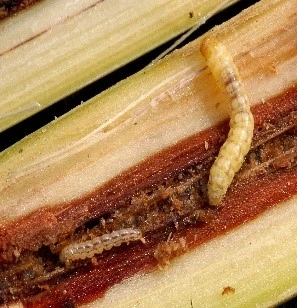
Top borer:
Damage:
A bunch of branches forms towards the top of the sugarcane. In winter, this insect is in the top of sugarcane in the state of larva.
Control:
Chlorantraniliprole + thiamethoxam 0.6 % (3-6 kg per acre) kera in lines at the time of sowing or broadcast after emergence.

Stem borer:
Damage:
Larva builds tunnels in the stem in July and the process continues till September-October. Branches appear on the side of the sugarcane. The damage is greater in drought.
Control:
Chlorantraniliprole 20 % (100-150 ml per acre) drench Or Fipronil 5 % (960 ml per acre) flood with irrigation Or Fipronil 80% (60 g per acre) flood with irrigation
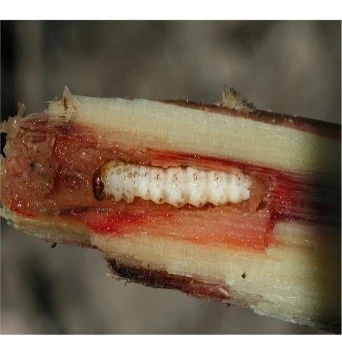
Root borer:
Damage:
The larva enters through a hole in the stem near the surface of the soil and goes down making a tunnel. 2-3 of leaves wilt and dry up along the plant shoot. It causes more damage to the short crop. The damage is more in drought.
Control:
Chlorantraniliprole + thiamethoxam 0.6 % (3-6 kg per acre) kera in lines at the time of sowing or spread after emergence.

Gurdaspur Borer:
Damage:
The larva cut the stem sheath into a circle just above the knot on top of the sugarcane and then form a spring-like tunnel. The upper part first wilts and then dries up completely. The upper part of the sugarcane affected by wind or touching can easily break. The attack usually takes place in the form of patches. Therefore, the damage can be estimated by standing at a high place around the field.
Control:
Chlorantraniliprole + thiamethoxam 0.6 % (3-6 kg per acre) kera in lines at the time of sowing or spread after emergence.
Note: Apply recommended chemicals with 30 days interval upto July 30 for borer control. Flood 30 tablets of phenyl with chlorpyrifos for control of stem borer, mealybug and whitefly. Spray Chlorpyrifos EC-40 at the rate of 1250 ml or Fipronil WDG 80% at the rate of 30 grams or Imidacloprid + Fipronil 80% at the rate of 100 grams per hectare at the time of sowing to control borers and termites.

Harvesting
Field selection for Ratoon crop:
Never select a field that is infested with disease and insects for keeping ratoon crop. From end of January to the beginning of March is very suitable time for keeping the ratoon crop.
Harvesting:
Stop irrigation 25 to 30 days before the harvest of crop and do not leave the harvested crop for long time in the field. In case it has to be kept for a prolonged period, it should be covered with trash. Different varieties planted may be harvested according to their maturity. Harvesting of early maturing varieties may be started during November, mid-season varieties during December and the late maturing varieties during January. The crop harvested during February - March gives good ratoon crop. Harvesting is done when the crop has fully matured and ripened. Early varieties and ratoon crops are the first to be harvested. When the stem is close to the surface, great vigilance is required in order to cut the maximum portion of the stem, which is valuable both for its weight and sugar content. The harvested cane should be immediately hauled to the mill otherwise weight and sucrose losses may occur.





.webp)
