Land Preparation and Sowing Method
Sesame (Sesamum indicum L.) is considered as an important oilseed crops. Owing to its high quality oil besides high content of protein (22.0%) it is described as the queen of oil crops. Its oil content ranges from 50-58%. Sesame is an oilseed crop cultivated in hot, dry climates for its oil and protein-rich seeds. In addition to raw food and confectionary purposes, sesame seeds are used in sweets and bakery products, as well as soaps, perfumes, vegetable oil and in carbon paper as well.
Potential areas for sesame cultivation in Pakistan are Gujrat, Sialkot, Gujranwala, Attock, Bhakkar, Faisalabad in Punjab, Tharparkar, Dadu and Hyderabad in Sindh, Kohat and D.I. Khan in Khyber Pakhtunkhwa and Naseerabad and Lesbela in Baluchistan.
Climate:
Sesame is mostly grown on light sandy soils as rain-irrigated crop in the semi-arid tropics and requires high temperature of 35-40 ℃ for vegetative and reproductive growth. This crop can mainly be grown in kharif season, and is very sensitive to excessive rainfall and water logging.
Soil Type:
Most suitable soils are those that possess the following properties:
- Sandy Loam Soils
- Well Aerated with Good Drainage
- pH Range = 6 - 8
- Not prompt to water logging.
Seedbed Preparation:
- 2 ploughings followed by 2 planking in fallow land.
- 2-3 ploughings followed by 2 planking if sowing after harvest of crop.
- In rain fed areas to save wattar 2-3 ploughings followed by 2 planking.
- Deep tillage through Chisel plough (at least every 3 years).
Sowing Time:
As kharif crop general sowing time is 1st May – 30th June. Sowing time may vary according to specific variety.
Seed Rate:
Optimum planting density is (87-88 thousands plants/acre) or 22 plants per meter is very important for achieving high yields. To ensure good germination and crop establishment, seeds with germination percentage of 85-90% must be planted. The optimum seed rate is recommended as under:
- Line sowing 1.5 -2 kg per acre.
- Broadcasting 6 - 8 kg/ha (3 kg per acre). Mix the seed with 6 - 8 kg sand and then broadcast
Sowing Methods:
| Line Sowing with Drill: | Broadcasting: | Ridge Sowing: |
|---|---|---|
| Row x Row distance = 1.5 feet (45cm) | Broadcast seed in well moist soil in both directions. | Prepare land. |
| - | Light planking followed by broadcasting. | Light planking followed by broadcasting. |
| - | - | Make ridges R x R = 1.5 feet |
| - | - | Light irrigation should be done after sowing. |
Importance of Thining:
- At four leaves stage before 1st irrigation
- Plant x Plant distance = 4″ - 6″
- Plant population must be 60,000/acre for Branched & 90,000/acre for Single stem
Approved Varieties of Sesame
- TH-6: 1st – 30th June
- TS-5: 15th june – 15th july
- Til- 18: 15th june- 15th july
- Niab Pearl: 15th june – 31st july
- Niab Til-2016: 15th june- 31st july
| Sr. No. | Variety Name | Year of Release | Sowing Time | Potential Yield(Maund/Acre) | Recommended Areas | Salient Features |
|---|---|---|---|---|---|---|
| 1 | TIL-18 | 2018 | 15th June-15th July | 24.96 | Irrigated Areas of Punjab | High yielding, branched with Cluster pods, Lodging and disease tolerant |
| 2 | TS-5 | 2011 | 15th June-15th July | 23.74 | Irrigated Areas of Punjab | High yielding and branched. |
| 3 | TH-6 | 2009 | 1st June-30th June | 22.41 | Irrigated Areas of Punjab | First single stem variety. High yielding. Due to its single stem and high temperature tolerance it is popular among farmers. |
| 4 | TS-3 | 2000 | 25th June-15th July | 22.41 | Irrigated Areas of Punjab | High Yielding and branched |
| 5 | Punjab Til-89 | 1990 | 25th June-15th July | 17.84 | Irrigated Areas of Punjab | First Sesame Variety in Punjab. Branched, High yielding and disease tolerant variety |
| 6 | Niab Pearl | 2017 | 15th June- 31st July | 377kg/ha | Irrigated Areas of Punjab | - |
Single Stem Vs Branched Varieties
| Single Stem | Branched |
|---|---|
| Branchless | Branched |
| R to R distance = 1.5 feet | R to R distance = 1.5 feet |
| P to P distance = 4inch | P to P distance = 6inch |
| Plant Population = 90,000/acre | Plant Population = 60,000/acre |
| TH-6 | TS-5, Til-18, NIAB Pearl, NIAB 16 |
Fertilizer Management
Nutrient Requirement (kg/acre) and Number of Bags/ Acre
| Nitrogen | Phosphorus | Potash | At Sowing Time | After Sowing |
|---|---|---|---|---|
| 34 kg | 24 kg | 12 kg | 1 bag DAP+ half bag SOP OR Half bag MOP | Apply half bag urea with 1st irrigation and half bag urea with 2nd irrigation |
Note: Application of 80 % Sulfur @4 kg / acre, at flowering stage significantly improves yield and oil content of seeds.
Irrigation
- 1st Irrigation: Seedling stage (After 20-25 days of Germination)
- 2nd Irrigation: At flowering stage.
- 3rd Irrigation: At pod formation.
- 4th Irrigation: At seed development.
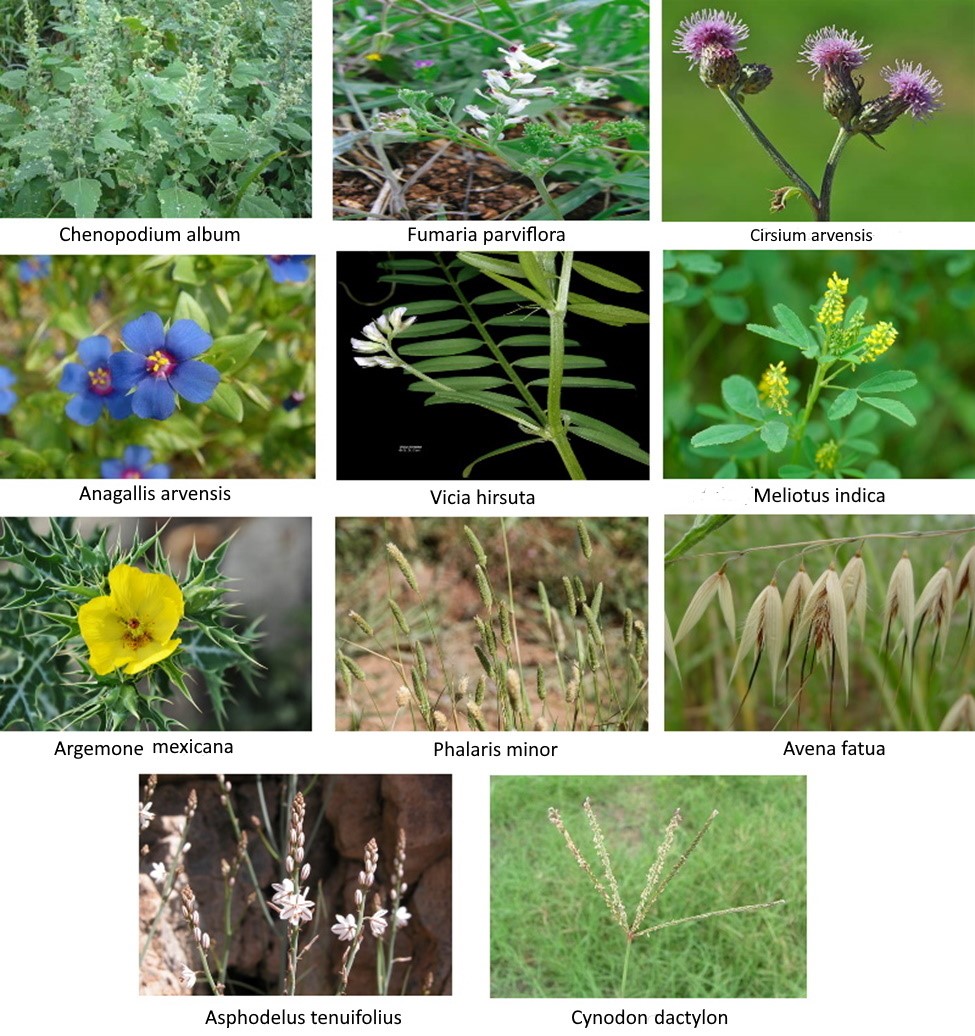
Weeds Management
- Manual weed control: 1st weed eradication before 1st irrigation (Dry Hoeing) and 2nd weed eradication after 1st irrigation at watter condition.
Chemical weed control
Pre-emergence: Pendimethalin @800ml/120 litre water after sowing at wattar condition.
Post-emergence: Quizalofop p ethyl @350 ml/120 litre water for control of grasses like swanki, khbal & baroo in sesame.
Effect Of Weeds:
- Compete for light, nutrients and water
- Increases insect/pests population
- Increases disease incidence
- Decreases harvesting efficiency
- Reduces yield considerably
Important instructions:
- Never use weeds as fodder purpose after spraying.
- Do not spray in strong wind, rain or fog. Use clean water to spray.
- Use a (flat fan or T-Jet) nozzle for herbicide spray.
- Spraying is advised to be followed after calibration of machine.
Sesame Diseases and their Management
1. Charcoal Rot
PATHOGEN: (Macrophomina phaseolina) (fungus) Seed and soil born (Yield losses upto 85%)
Factors affecting Disease Development:
- High soil temperature above 35℃.
- High salt concentration in irrigation water or soil
Symptoms:
- In seedling stage roots become brown and rotted.
- Old plants affected at the base of stem.
- Blackening of stem may extend upward on stem.
- Finally stem become dry and plant die.
MANAGEMENT/CONTROL:
- Seed treatment with systematic fungicide for sowing Topsin-M (Thiophanate methyl)2g/kg of seed.
- Crop rotation and destruction of plant disease debris.
- Use the clean and bold seed for sowing
- Chemical control (flood Thiophanate methyl @1kg/acre).

2. Phyllody Disease of Sesame
PATHOGEN: (MLO) (Micoplasma like organism) (Losses upto 90%) Alternate host, sucking insect (secondary infection)
Factors affecting Disease Development:
Transmitted by leaf hoppers and Jassids
Symptoms:
- In early stage of infection stunted growth of plants.
- Shorting of internodes
- Transformation of flower parts into green leaves like structure.

3. Bacterial Blight of Sesame
PATHOGEN: (Xanthomonas campestris pv. sesami)
Symptoms:
Water soaked, small and irregular spots are formed on the leaves, which later increase in number and turn brown, under favorable conditions, severely infected leaves shed. Later, the spots are formed on the twigs, which bear poor capsules.
Management/ Control:
- Seed treatment with hot water at 52 ºC for 10 minutes
- Foliar spray of kasugamycin+ copper oxychloride @65 grams/acre as soon as symptoms are noticed. Continue alternately two more sprays at 15 days interval if necessary.

Insect/ Pest and their Management
1. Whitefly
It transmits 50 different plant viruses on 70 different plants
- Nymphs are oval, scale like and remain attached to the leaf surface.
- Adults are tiny, moth like with yellowish body and wings coated with milky white waxy powder.
- ETL 5/Leaf
Damage:
- Both Nymph and adult suck cell sap, Secrete honey dew, sooty mold grows, cause blackening of leaves.
- Attack is higher in hot and dry season
CHEMICAL CONTROL:
- Spirotetramat 240 SC @125ml+Biopower @ 250 ml/acre
- Pyriproxyfen 10.8 EC @ 400 ml/acre (for nymph control)
- Acetamiprid 20 SP @ 150 gm/acre( nymph+ adult)

2. Jassid
- Very active, greenish in color
- ETL 1/Leaf
Damage:
- Both adult and nymph suck cell sap.
- Infested leaves firstly turn yellow then turn brown and ultimately fell down.
CHEMICAL CONTROL:
- Imidacloprid 200SL @ 100 ml / acre
- Nitenpyram 10 AS @ 200ml/acre
- Dinotefuran 20 SG @ 100 g/acre

3. Mirid Bug (Nesidiocoris tenuis)
- Visibly similar like Jassid but its legs are comparatively longer
- Yellowish green in color
- ETL is 6/Plant
Damage:
- Sucks sap from the plant
- Emit toxins, leaves are dried and crop seems like burnt crop
- Damages the reproductive part of the flower and pods
CHEMICAL CONTROL:
- Carbosulfan 20 EC @ 500ml/acre
- Clothianidin @ 200 ml/acre

4. Leaf Webber/Capsule Borer
- Larvae are whitish at initial stages
- Larvae turn into green color having black spots
Damage:
- Young larvae roll together top leaves and feed them.
- In initial stages, plant dies without producing any branch.
- Infests the capsules and severely affects seed formation.
CHEMICAL CONTROL:
- Lambda-cyhalothrin 2.5 EC @ 330 ml/acre
- Emamectin Benzoate 1.9 EC @ 200 ml/acre

Harvesting of Sesame
When 90-95% leaves fall off from the plants and ¾ part of leaves, capsules, stem turns yellow than harvest the crop before opening of pods.
- 8% Moisture in crop.
Post Harvest Care:
- Dry up harvested crop for 8-10 days
- Thresh dry crop manually by stick an than Winnowing
- Thresh crop when moisture content of the seed is 12-15%
- Dry up the Threshed seed up to 8% moisture level.




.webp)
