Land preparation and sowing method
Importance
Pulses are important source of human food and animal feed. It contains 25 – 30% protein and is cultivated on 5% of total cropped area. Pulses play an important role in sustaining soil fertility by fixing atmospheric nitrogen and improving soil physical properties. Being drought resistant crops, mung and mash bean are suitable for dryland farming and can be intercropped with other crops. Beside protein, they are also a good source of carbohydrate and vitamins.
Land preparation
Well pulverized land with adequate moisture supply is a pre-requisite for pulses production. Mung bean and mash bean can be cultivated in wide range of soil except saline and water-logged soils. Loamy to sandy loam soils are best for its production. Residues from previous crop should be mixed in the soil with the help of disc harrow or rotavator. Besides, land should be leveled using laser land leveler for even irrigation. Plough the land before rauni irrigation (or before rainfall in barani areas). After that 2 cultivation followed by land leveling is necessary to achieve better soil tilth.
Sowing method
Drill sowing with row to row spacing of 1 foot is suitable for mung and mash bean cultivation. However, a wider spacing of 1.5 – 2 feet between the row is optimum for kharif sowing in irrigated areas. It can also be sown through kera or pora method (traditional methods) if drill is not available. Bed sowing is suitable in high rainfall receiving arears.
- According to NIAB Faisalabad, better results can be obtained by maintaining the row spacing of 2.5 feet for NIAB mung.
For maintaining a plant to plant distance of 3 – 4 inches, thinning should be done at 4 to 5 leaf stage in barani areas and before first irrigation (after sowing) in irrigated areas.
Approved Varieties in Pakistan
| Mung bean | Mash bean |
|---|---|
| Jumbo mung | Arooj-2011 |
| Abbas mung | NARC mash-3 |
| NIAB mung-2021 | Chakwal mash |
| AZRI mung-2021 | Barani mash |
| AZRI mung-2018 | Mash-97 |
| PRI mung-2018 | HSF-350A |
| Bahawalpur mung-2017 | S-287 |
| NIAB mung-2016 | |
| AZRI mung-2006 | |
| Chakwal mung-6 |
• Seeds should be treated with Thiophanate methyl @ 2g per kg of seeds to protect the crop from various fungal diseases.
Seed rate and plant population
| Mung | Mash | ||
|---|---|---|---|
| Seed rate/ acre | Plant population/ acre | Seed rate/ acre | Plant population/ acre |
| 10 – 12 kg (it can be increased by 2 to 3 kg in case of windy season) | 1 lac 60 thousand – 1 lac 80 thousand | • 8 kg (10 kg for high rainfall receiving areas) • For Mash-97: 5 – 6 kg |
1 lac 60 thousand – 1 lac 80 thousand |
*for conversion of values into hectare, multiply mentioned value with 2.471.
Optimum sowing time
| Mung | Mash | ||
|---|---|---|---|
| Spring sowing | Kharif sowing | Spring sowing | Kharif sowing |
| 15th March – 15th April | • Irrigated areas: 15th April – 20th May • Barani areas: From onset of monsoon till 15th July |
1st – 31st March Although, in South Punjab it should be completed before 15th March |
• Irrigated areas: 1st July – 31st July • Barani areas: End of June – Mid of July |
Seed treatment with Rhizobium culture
Seed treatment with Rhizobium species increases the ability of plants to fix atmospheric nitrogen and uptake phosphorus more efficiently from the soil, which eventually leads to more production. It also improves soil fertility and make biologically fixed nitrogen available to upcoming crops being grown after harvest. The treated seeds should be used within 24 hours.
Method:
Prepare a solution by adding 150 g of jaggery or sugar in 750 ml water. Apply this solution to the seeds and shake gently, so that adhesive material may spread more evenly. Sprinkle the required quantity of bio fertilizer on seeds and keep shaking it for even surface coating over the seeds. Dry the coated seeds in shade for 30 minutes and sow them without any delay.
• Rhizobial strains can be obtained from research institutes i.e. AARI Faisalabad, NIAB Faisalabad and NARC Islamabad.
Fertilizer Management
| Soil Fertility | Dose (Kg/ acre) | Bags/ acre |
|---|---|---|
| Medium fertile soil: • 0.87% – 1.29% organic matter • 7 – 14 ppm phosphorus and • 80 – 180 ppm potassium |
• Nitrogen: 9 kg • Phosphorus: 23 kg • Potassium: 12 kg |
1 bag DAP + 1 bag SOP |
- Apply complete dose of fertilizers in the field before sowing.
- Growtech recommends different doses of fertilizers according to different fertility zones present across the field.
Ammonium sulphate:
Ammonium sulphate is a good source of Sulphur along with nitrogen. It has lower susceptibility to N losses from volatilization and leaching. Readily available to plants with high nutrient efficiency. Make the fixed nutrients available to plants. Sulphur being a fungicide as well as food, provides protection against various fungal diseases.
Dose: 25 – 50 kg/acre with first irrigation
Potash 30%:
Potash plays an important role in increasing number of pods and pod length in case of pulses.
Dose: 100 ml per 20 Liter water. Spray 2 times during pod formation with an interval of 10 days.
Multi-micronutrients (Zn, Fe, Mn and Cu):
Plants respond to foliar spray immediately as compared to soil application.
Dose: 100 ml per 20 Liter water. First spray should be done 25 days after sowing (DAS) and second application should be 40 DAS.
Irrigation
Three to four irrigations are generally required, depending upon the crop requirement and weather conditions. It can be skipped in case of rainfall.
- 1st irrigation: 3 to 4 weeks after germination
- 2nd irrigation: at flowering
- 3rd and 4th irrigation: at pod or seed formation (depending upon the crop requirement)
Weeds and their management
| Chemical Name | Dose per acre | Time of application | Method of application |
|---|---|---|---|
| Acetochlor + Pendimethalin 45% | 1000 ml | Before emergence | Spray before planking |
| Fomesafen 21.8% + Quizalofop P ethyl 15% (tank mixture) | 200 ml + 250 ml | After emergence (at 2 – 4 leaf stage) | Spray after first irrigation in moist conditions |
- Weedicide should be sprayed using T-jet nozzle.
- 100 – 120 Liter clean water should be used.
Diseases and their management
1. Yellow mosaic virus:
This virus is transmitted through whitefly. Scattered yellow spots appear on young leaves which later combine together into irregular yellow patches. In severe cases, there is complete yellowing of leaves, resulting in reduced photosynthetic efficiency. Pods in infected plants are small and curled upward with few and small seeds. Stunted growth and chlorosis contribute to significant yield losses.
Control:
- Whitefly should be controlled.
- Affected plants should be uprooted from the field at early stage.
- Clean and graded seeds of disease resistant varieties should be used.
- Spray Amino acids or Multi-micronutrient @ 250 – 500 ml/acre (in 100 Liter water)
2. Urdbean leaf crinkle virus:
Symptoms like leaf crinkling, leaf edge curling, and light green coloration with thickened veins can be observed in young leaves. Older leaves appear to be thick and rough on touching. Veins show reddish brown discoloration, while petioles and inter-nodal distance get shortened. At flowering stage, calyx appears to be rough and darker in color and inflorescence look like a bunch. Pollens become sterile and plants bear few buds and pods, causing heavy yield losses. Infected plant gives stunted and bushy appearance. Aphids transmit this virus from infected plants to the healthy plants.
Control:
- Aphids and their host weeds should be controlled.
- Rough out the diseased plants with the interval of 8 to 10 days.
- Clean and graded seeds of disease resistant varieties should be used.
- Spray Amino acids or Multi-micronutrient @ 250 – 500 ml/acre (in 100 liter water)
3. Anthracnose:
Small irregular-sunken reddish brown spots appear on the surface of the leaves, which coalesce together to form large dark-sunken lesions. The process of photosynthesis slows down, which eventually leads to stunted plant growth and shedding of fruit bodies.
Control:
Spray Pyraclostrobin + Metiram 60% WDG @ 600 g/ acre (in 100 Liter water) or Trifloxystrobin + Tebuconazole 75% WG @ 65 gram (in 100 Liter water).
4. Cercospora leaf spot:
Almost 20 to 25 days after sowing, small water-soaked brown spots with yellow halos appear on the surface of leaves. As the disease progresses, the spots turn dark brown with reddish brown margin. The lesions dry and pieces fall out giving a ragged look. The spots also develop on the pods and fungus grows inside them.
Control:
Spray Pyraclostrobin + Metiram 60% WDG @ 600 g/ acre (in 100 Liter water) or Trifloxystrobin + Tebuconazole 75% WG @ 65 gram (in 100 Liter water).
5. Fusarium wilt:
In this disease, plant starts to wilt on sunny afternoons, but recovers when the temperature drops. With time, the infection spreads through the whole plant. Leaves and stem appear to be chlorotic. The infection results in slow growth and reduced yield.
Control:
Apply Thiophanate methyl 70% WP @ 1 Kg/ acre or Fosetyl aluminium 80% WP @ 1 Kg/ acre through flooding.
6. Stem and Root rot:
Symptoms include stem and root wilting, development of blackish brown lesions on roots and red discoloration of vascular system due to which plants dry up and fall down.
Control:
Apply Thiophanate methyl 70% WP @ 1 Kg/ acre or Fosetyl aluminium 80% WP @ 1 Kg/ acre through flooding.
7. Collar rot:
In this disease, foliage turns yellow, falls off and scatters in the field. The joint of stem contracts and begins to decay. Infected parts turn brownish white. Sclerotia (hyphae) appears on the infected parts of the plant.
Control:
Apply Thiophanate methyl 70% WP @ 1 Kg/ acre or Fosetyl aluminium 80% WP @ 1 Kg/ acre through flooding.
8. Bacterial leaf blight:
Symptoms include developments of water-soaked, circular, dark green colored spot on leaf surface which affects the process of photosynthesis. As the spots turn old, become reddish brown in color and get covered with bacterial ooze in extremely humid condition.
Control:
Spray Copper oxychloride + Kasugamycin 47% WP @ 250 g/ acre (in 100 Liter water)
Insects / pests and their management
1. Termites:
Symptoms:
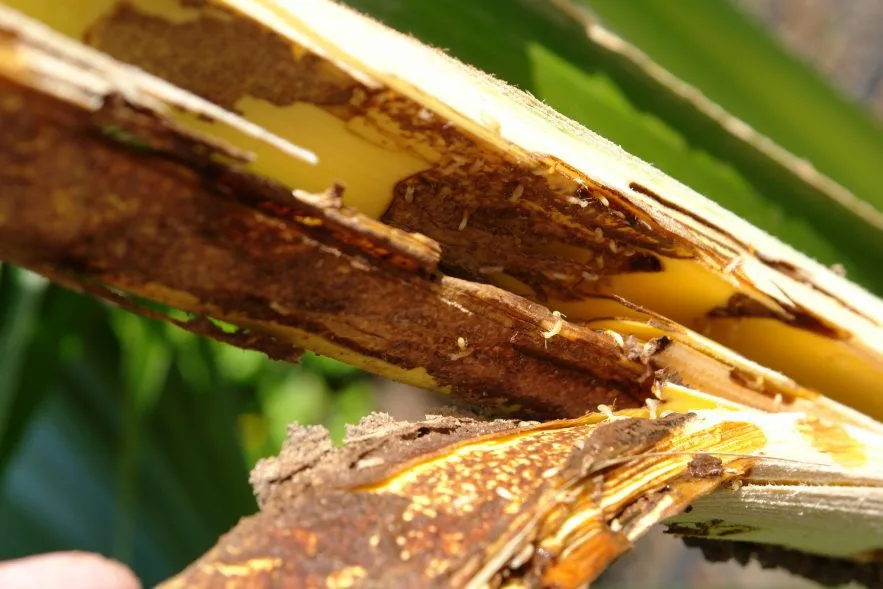
Termites are light brown in color and have ant-like appearance. It directly attacks the root and stem of plants. When roots and stems are being fed internally, they become weak. As a result, water and nutrients provision to plant is blocked. The plant dries up and falls on the ground.
Control:
Chlorpyriphos 40% EC @ 1.5 to 2 liter/acre (through flooding) Or Fipronil 5% EC @ 1 liter/acre (through flooding)
2. Grass hopper:
Symptoms:
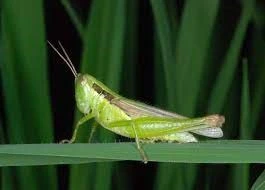
Grasshoppers directly attack the crop and feed on leaves and seeds, causing defoliation and economic losses.
Control:
Spray Lambda cyhalothrin 2.5% EC @ 250 ml/acre Or Bifenthrine 10 EC @ 250 ml/acre
3. Whitefly:
Symptoms:
• Leaves give sickly appearance because both nymphs and adults suck the sap usually from the under surface of the leaves and excrete honeydew.
• The leaf surface gets coated with sooty mold due to which the process of photosynthesis slows down, which eventually leads to stunted plant growth and shedding of fruit bodies.
Insect is also responsible for the transmission of various viral diseases.
Control:
Flonicamid 50% DF @ 80 g/acre Or Spirotetramate 240% EC @ 125 ml/acre Or Pyriproxyfen 10.8% EC @ 500 ml/acre Or Acetamiprid 20% SP @ 125 to 150 g/acre

4. Jassid:
Symptoms:
The insect is greenish yellow in color. Nymphs and adults suck sap usually from the under surface of the leaves due to which leaves dry up and shed. They also inject toxins causing curling of leaf edges and leaves turn red or brown.
Control:
Flonicamid 50% DF @ 60 g/acre Or Imidacloprid 200% SL @ 100 ml/acre Or Carbosulfan 20% EC @ 300 to 500 ml/acre

5. Aphid:
Symptoms:
This insect has greenish color. They form colonies on the under surface of the young leaves and suck sap from leaves and shoot resulting in crinkling and curling of leaves. Honeydew excreted by the insects gives shiny and sticky appearance to the leaves. Later sooty mold grows on honey dew and leaves have a black coating.
Control:
Imidacloprid 200% SL @ 200 to 250 ml/acre Or Carbosulfan 20% EC @ 500 ml/acre

6. Cutworm:
Symptoms:
Cutworms are greenish brown in color with shiny black head. They damage the crop by cutting young plants from ground level at night.
Control:
Bifenthrine 10% EC @ 400 ml/acre
7. Pod borer:
Symptoms:
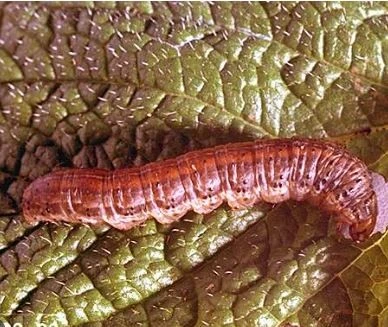
Pod borers enter inside the pod by making hole in it and feed on seeds (inside the pod) and leaves. A single borer can damage 30 to 40 pods.
Control:
Flomect 5% EC @ 70 ml (in 20 liter water)

8. Spinola bug:
Symptoms:
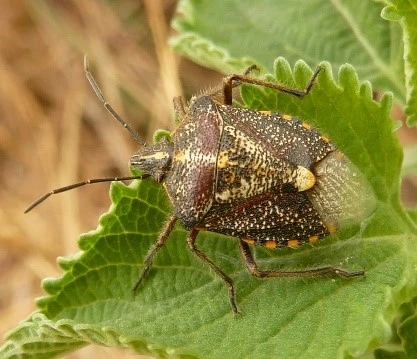
Insect attacks mung bean crop when it is about to harvest. It sucks sap from pods due to which pre-mature drying of pods can be observed. Crop should be harvested on time to avoid its attack.
Control:
Clothianidin 20% SC @ 50 ml (in 20 liter water)
9. Army worm:
Symptoms:
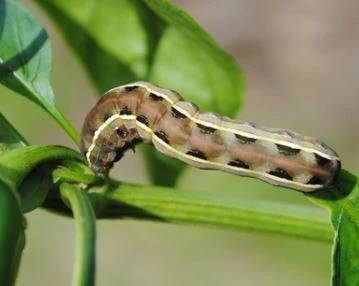
The caterpillar initially feeds on the plant tissues on the underside of the leaves. In case of severe attack, larvae starts feeding on all plant parts causing extensive loss of leaves.
Control:
Emamectin benzoate 1.9% EC @ 200 ml/acre Or Leufenoron 5% EC @ 200 ml/acre
Harvesting
Crop is ready to harvest when 80 to 90 percent pods dry up. Harvest the crop in morning using combine harvester (after speed adjustment). Harvested produce should be sun-dried for 4 – 5 days and then threshed using thresher or by beating with wooden stick.
Storage:
- For storage purpose, moisture contents of seeds should not be more than 10%.
- Clean storage houses properly and spray suitable insecticide at every corner.
- Disinfect old sacks and sun dry them before storing pulses.
- Harvested produce should be stored in hermetic sacks to avoid seed deterioration and insect/ pest attack.





.webp)
