Fig Production Plan by GROWTECH
Importance
Fig is a type of flowering plant, was first cultivated in the countries of West and South Asia. Fig is a soft and sweet fruit. It has many seeds which is available in different colors and looks like a tree. Fig is among six fruits mentioned in the Holy Quran. The other five fruits are grapes, bananas, olives, pomegranate and dates. About 18,000 tons of figs are produced annually in Pakistan, while there is an annual demand of around 28,000 tons of figs. Therefore, to meet this demand, we have to import 10,000 tons of dried fig to meet the local requirements.

Production, Import and Export:
The area under fig cultivation in Pakistan is 410 acres, which yields 755 tons of fresh fruit. Pakistan is an importer of dried figs as its own production is insufficient to meet the needs of its growing population. Turkey, Afghanistan and Iran are the main exporter countries of figs.
Climate and Soil:
Fig is a shrub-like small tree that is native to Southwest Asia and arid regions. It grows best in arid or semi-arid climates, with high summer temperatures, plenty of sunshine and mild winters. Although the plant can survive up to 45°C temperature, fruit quality deteriorates after 39°C temperature. Large trees can withstand temperatures as low as 4 °C, but smaller plants are susceptible to abiotic stress. However, due to the ability of the fig plant to shed its leaves, it can tolerate temperatures up to 10 °C during dormancy. Because of its large leaves, it needs more water. If figs are grown in dry areas, their leaves drop quickly and yield is affected. The optimum temperature for figs is 16-21 °C. Figs can be grown in any type of soil as it tolerates salinity in the soil, but for high yields, medium to heavy well-drained soils with a pH of 8-7 are best for good fig production.
Approved Varieties of Fig
Most recommended varieties of figs:
- Black Mission
- Brown Turkey
Besides this, California White, Sawari Smyrna, Green Ischia etc. These are also recommended varieties of figs.
Sowing Time:
The best time for its planting is the beginning of the rainy season. Figs can be sown at any time of the year, but the best time to sow them is during dormancy. It is more suitable to cultivate figs in December and January.
Method of Planting:
The planting arrangement can be square which is more common method in practices nowadays. Spacing depends on both plant and soil type. Pits of 60 cm length, width and depth are dug and left open in sunlight for 15 days. They are then filled with an equal weight mixture of compost, topsoil and sand. The fig plant starts bearing fruit after two years. Also it spreads over the whole place in about five years. For this reason, we can plant something else in the fig garden in the early years. Cuttings of the previous season with 3 to 6 nodes about 25 cm long should be used as planting material
Each year after leaf fall and before the leaves and shoots emerge in the spring, the plant is pruned back substantially, such as falsa, leaving the stem only 3 to 6 inches above the ground. From this, about 60,000 to 70,000 cuttings can be obtained from one acre for planting in the nursery. Thus, the plant starts bearing fruit in less than a year.
Plant to Plant and Row to Row Distance:
Plant spacing should be 2.5 to 6 feet in the ground depending on the type of plant and soil fertility. 260 trees can be planted in one acre with a spacing of 13 × 13 feet. Figs can be propagated by seeds and grafting.
Irrigation
High Density Plantation:
In short-spacing plantings, plant spacing is one foot and row spacing is 25 feet. In this way about 18000 plants can be planted per acre.
Irrigation:
Irrigation is very important for fruit formation and optimal growth. The irrigation requirement of a fig plant also depends on the soil conditions. Mostly irrigation is done at weekly intervals after planting.
| Month | Irrigation intervals (day) |
|---|---|
| January-February | 12-14 |
| March- April-May | 8-12 |
| October – November | 8-10 |
| December | 15-20 |
Note: Water Deficiency during fruiting can cause the fruit to become hard and small in size. While excess water causes cracks on the outer surface of the fruit and loss of flavor.
Fertilizer Management
Use of Fertilizer:
Plant nutrient requirements Varies from soil to soil & crop to crop. Fig plants need regular fertilization for their optimal growth. Fertilizer for small plants can be applied at the onset of monsoon and immediately fertilized after harvesting for those plant that have started producing. The annual requirement can be divided into two types of use. Apply half of the fertilizer after harvest and the other half of the fertilizer applied after two months when the syconia are forming. Nitrogen is very important for their growth and development. Potassium is essential for high quality and yield. Amonium sulphate can be used as source of nitrogen & SOP (sulphate of potash) can be used as source of Potash.
Recommendations for use of fertilizers:
| Age of Plant | Nitrogen(g) | Phosphorous(g) | Potassium(g) |
|---|---|---|---|
| 1-2 year old | 75 | 50 | 50 |
| 2-5 year old | 150 | 100 | 100 |
| Above 5 year | 300 | 200 | 200 |
Pruning and Thinning:
The fig tree is initially pruned as a single trunk to form a broad, symmetrical crown with a strong core and uniform spread all around. The tree is allowed to grow to about one meter and then it is cut at the top, which allows surrounding branches to grow around the trunk. The inner parts of the fig tree should be kept dry and protected from sap-sucking insects and diseases. Figs are pruned on an annual basis to stimulate new growth and fruiting parts.
The timing and type of pruning varies from place to place with the type of plant and the annual yield of the crop. The best time to preserve the ripe crop is during dry and hot weather. That is why pruning is done 4 to 5 months before. Care should be taken when pruning a one-year-old fig plant. Figs always bear fruit on new branches, so after a year the old branches should be carefully pruned. Some varieties of figs have long, upward branches that droop after a few years and it harm the plant. In such case, the branches should be cut to 18 inches. Some varieties of figs bear fruit twice a year. For this reason, these varieties require more pruning to maintain the beauty of the plant.
Insect/ pest and their Management
Stem Borer
These insects make holes in the trunk and eat the bark of the tree and then lay eggs there and finally damage the fig plant. To prevent this, the affected branch should be cleaned and where there are holes, an iron wire and then a piece of bread soaked in chloroform (CHCl3) should be placed there.
OR spray Emamectin + Lufenuron 3% @ 200ml in 100 liters of water.

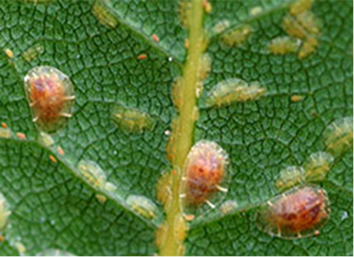
Brown Scale
These are small insects that stick tightly to the bark and then suck the sap and damage the bark. To prevent this pest, the plant should be sprayed at the beginning of January, especially in the places where new shoots emerge. For control, spray lambda cyhalothrin @ 2.5 ml per 100 liters of water.
Diseases and their Management
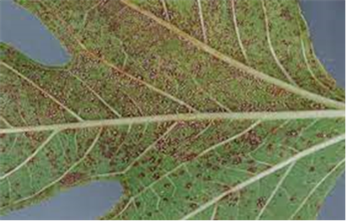
Fig Rust
The disease first appears as historical spots on the leaves and then grows and spreads as the plant grows and eventually drops the leaves. The fruit drops before ripening. To control fig rust, a spray of Bordeaux mixture, potassium sulfate and lime water (50:3:3) [Ref: Fig in Pakistan /انجیر کی کاشت, ZTBL, Pakistan]
OR Trifloxystrobin + Tabuconazole 75% @ 65g per 100 liters of water.
Physical Disorder
Figs are quite susceptible to sunburn, fruit cracking and fruit drop. Most of the cases of sunburn have been observed in small plants and also in those that are heavily pruned. Stems and shoots exposed to direct sunlight are more susceptible to sunburn. The affected area cracks and peels off, making it susceptible to fungal infections and other diseases. A well-pruned canopy protects the plant from scorching sunlight. This makes the fruit inedible. Because the pulp of the fruit becomes vulnerable to insect attack and other diseases.

Harvesting
The harvesting of the fig crop depends on its use. About 90% of the figs produced in the world are dried, but most of the figs produced in Pakistan are sold fresh. Fresh figs should be harvested when they are soft and slightly wilted from the neck side. In some parts of the world, figs are harvested by machines, but in our country, figs are harvested by hand on the trees by cutting the end of the stem or by slightly twisting the neck. About 5 tons of fresh figs can be produced from one acre. When figs are grown for drying purposes, they are allowed to ripen and partially dry together on the tree and then fall to the ground by themselves. For this reason, the lower part of the tree should be clean and dry during the time of their fall. After 2 to 3 days the figs are collected for further processing.




.webp)
