Mango Production Plan by GROWTECH
Introduction
- King of fruits mango is one of the most popular and 2nd major fruit crop in Pakistan. It is grown in Punjab and Sindh provinces of Pakistan.
- Mango is rich source of Vitamin A.
- Its leaves are used as fodder in case of shortage of fodder while wood is used for furniture making.
- Unriped fruits are used for chutney, pickles and ripe fruits are used for eating purpose as well as for syrups, jam and jelly.
- Mango fruits of various cultivars differ greatly in shape, size, appearance and internal characteristics.
- The quality of fruit is based on scarcity of fibr and sweetness
Popular Cultivated Varieties of Mango in Punjab
| Variety | Cultivated Area (%) |
|---|---|
| Azeem chaunsa | 37 |
| Sindhri | 16 |
| White chaunsa | 14 |
| Black chaunsa | 7 |
| Dusehri | 6 |
| Langra | 5 |
| Anwar ratoul | 3 |
| Fajri | 2 |
| Other varities | 6 |
Popular Varieties With Their Yield
Azeem chaunsa
- New variety of mango having high yield potential with small fruit size.
- The average weight of the fruit is 225g and its sweetness is about 24%.
- The pulp of the fruit is deep yellowish and its shelf life is very long.
- Its fruit is not affected by winds.
- Fruit ripens in the second week of August but can be kept on the plant till the end of October.
- This variety is cultivated on hundreds of acres in the areas of Alipur, Bahawalpur and Jalalpur.
- It is a very popular variety in the markets of Europe, America and Canada.
- Its area is also increasing rapidly.

Langra
- Fruits are medium to large, smooth having lemon yellow color.
- Flesh is fibreless with fine taste.
- Skin of fruit is medium thick.
- Fruits are ready to harvest in second week of July.
- It gives average yield of 100kg per plant.
- Its shelf life is very short due to which it cannot be reach to distant markets.
- It is suitable variety for salt affected soils.
- In Punjab, its cultivation is on 4% of the area.
- This variety is not being cultivated in orchards and its area is also decreasing.

Sufaid Chaunsa
- It is a good tasting and late variety.
- Average weight of fruit is 350g.
- The color of the fruit is white and yellow.
- It has average production of 250kg/plant.
- Major part of its production is exported.
- It has a long shelf life and is a suitable variety for international markets.
- This variety of mango also has the ability to keep the fruit on the plant for a longer period of time.
- Major part of its production is exported to foreign countries and this variety is popular in many countries of the world.
- Its cultivated area is increasing rapidly and currently 15% of the area is under cultivation.
- Riverine areas are more suitable for its cultivation.
- This variety has the highest water requirement and its fruit is more affected by heat.
Dusehri
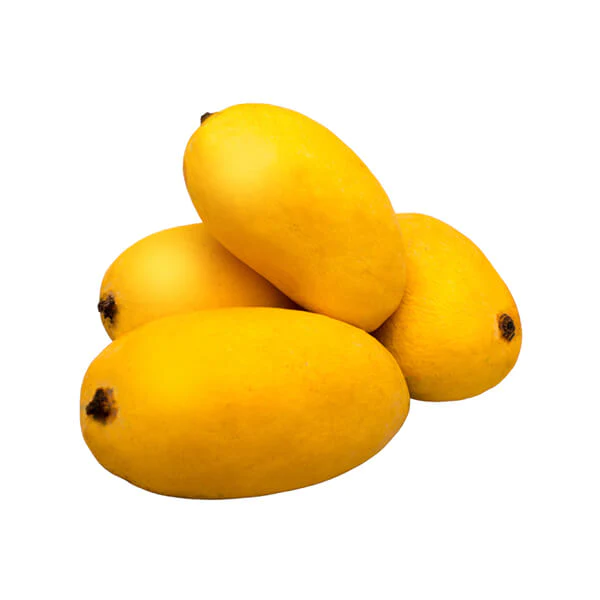
- Fruits are ready to harvest in first week of July.
- Fruits are small to medium size, smooth having yellow color, sweet in taste.
- Fruits are having better keeping quality.
- It is regular bearing crop.
- It gives average yield of 150kg/plant.
- It has a short shelf life, hence it is limited to local markets.
- Its cultivated area in Punjab is 6% and is continuously decreasing.
- This variety also has good salt tolerance.
- It is the only mango variety that tolerates sodium salts.
Sindhri
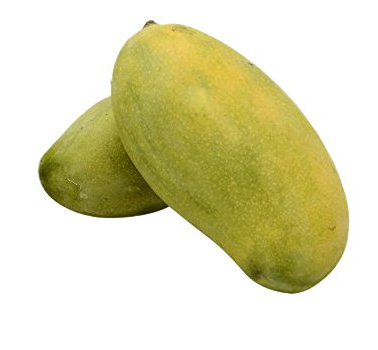
- It is a good tasting and late variety.
- Average weight of fruit is 380g.
- Its seed is thin and long.
- Average production is 260kg/plant.
- Its shelf life is very good. Therefore, this type is of special importance for local and international markets.
- Sindhri mango is exported to different countries of the world.
- Due to its increasing demand and export in the international markets, the area under its cultivation in Punjab is continuously increasing.
- It is the second largest variety in Punjab which is cultivated on 16% area and its area is continuously increasing.
Anwar Retaul
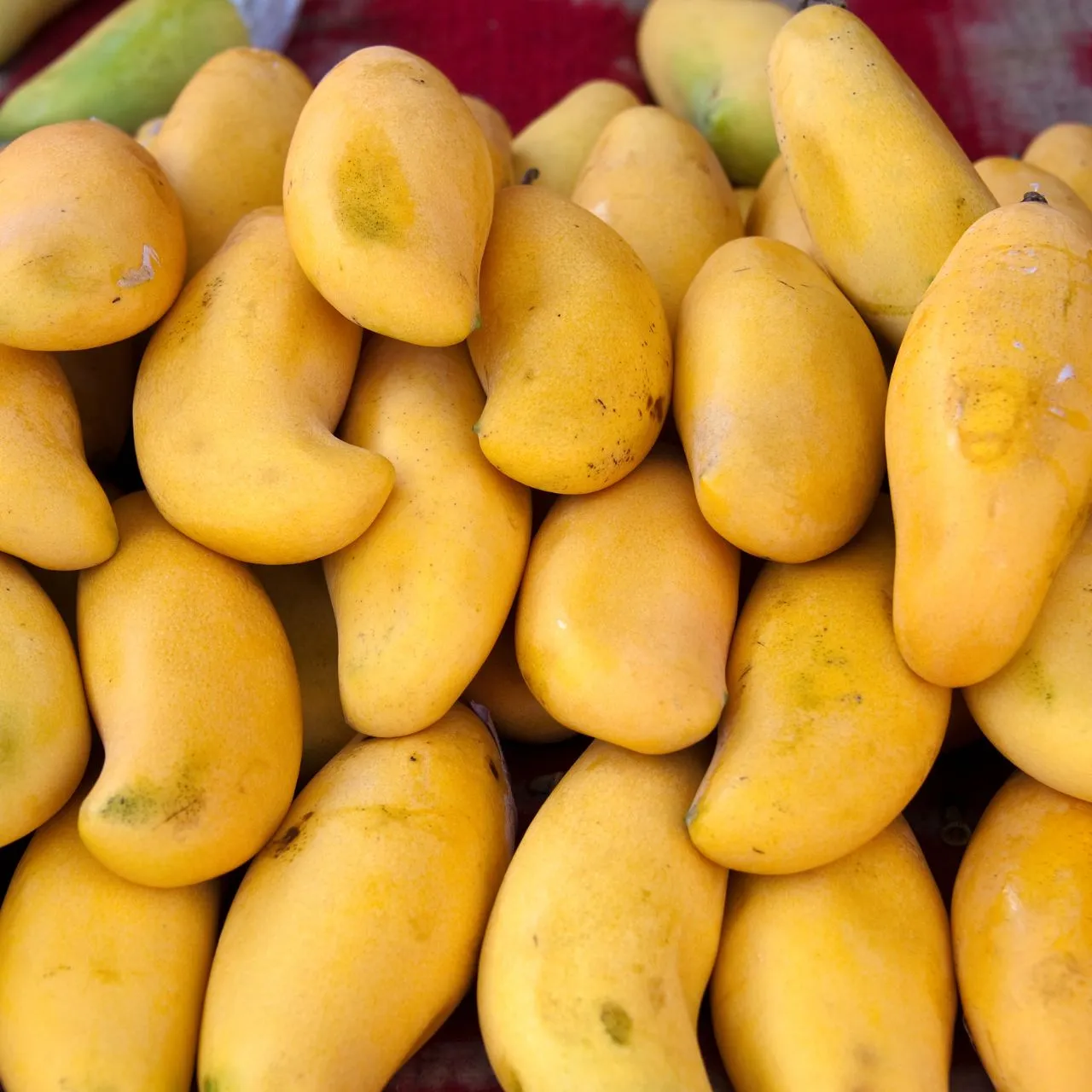
- It is an early mature variety with good taste.
- Its trees are of medium size.
- The average weight of its fruit is 200g and the color of the ripped fruit is light yellow.
- Its pulp is free from fiber and seed is small in size.
- It has an average yield of 220kg/plant.
- It is a very popular variety in local markets and not suitable for export purposes.
Yakta
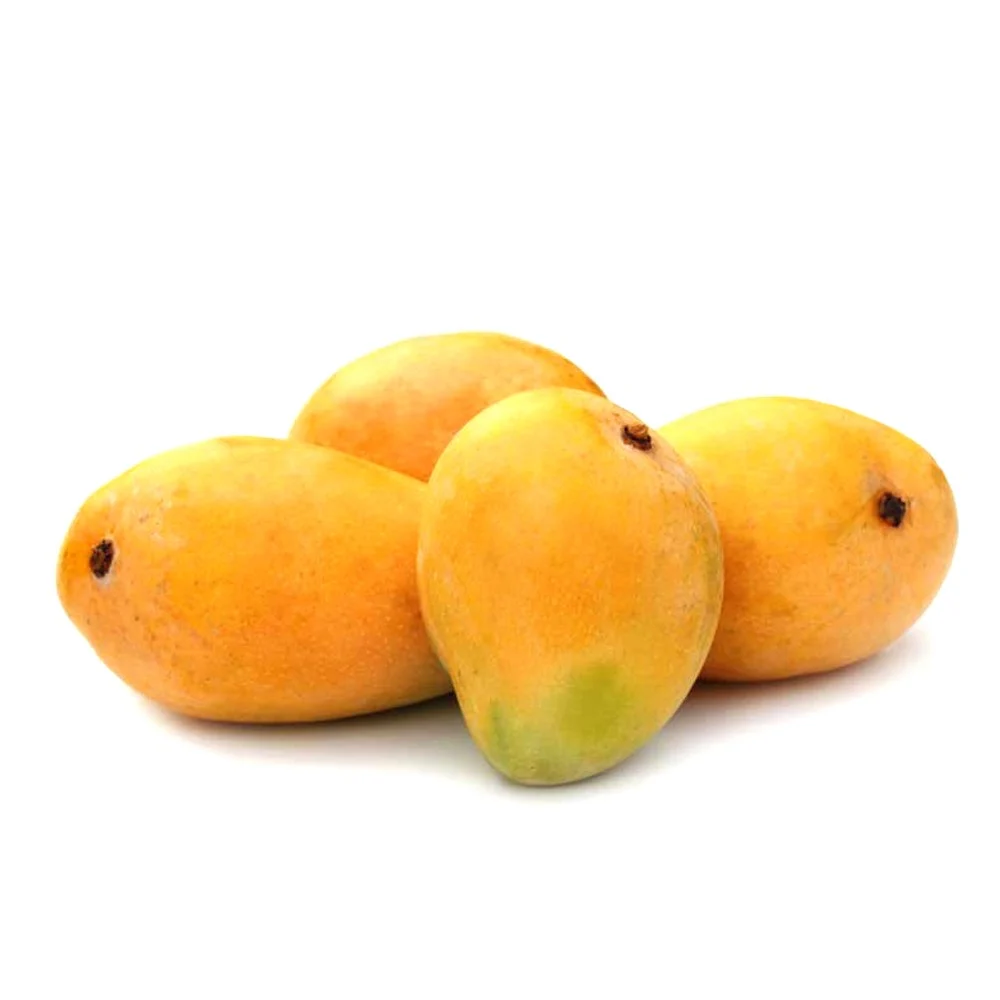
- It is an early mature variety with good taste.
- Its plan
- It is tall and bears fruit every year.
- The average weight of the fruit is about 350 grams, the color of the fruit is yellow when ripe, while the color of the pulp is dark yellow.
- The seed is large in size.
- The sweetness of the fruit is about 22 to 23 percent.
- The average yield of the plant is 160 kg/plant.
- The shelf life of the fruit after ripening is short so it is not suitable for distant markets but is a better variety for local and nearby markets.
- This new variety is cultivated on a very small area, hence it is not recognized in all markets.
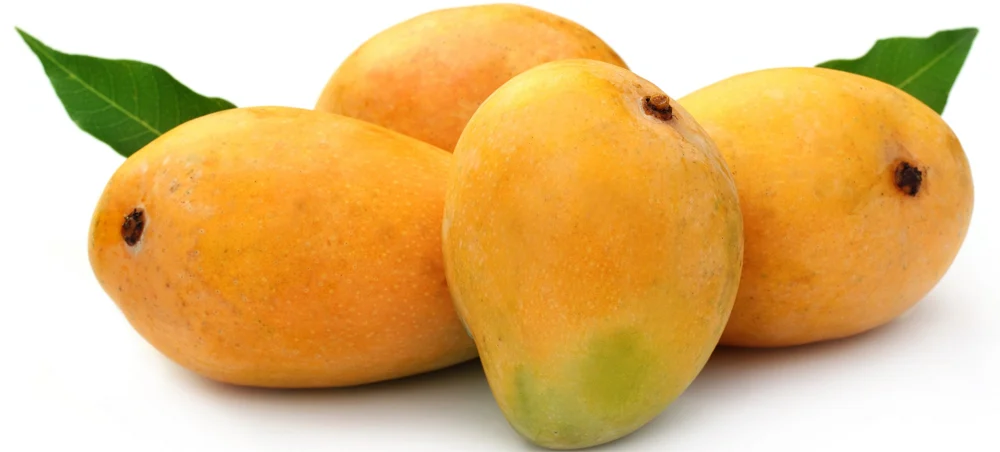
Fajri
- Its trees are heighted.
- The average weight of the fruit is 380 grams.
- After ripening the color of the pulp becomes dark yellowish.
- Its pulp is juicy.
- Seed size is medium thick and long.
- The sweetness in the fruit is 22-23%.
- The average yield of the plant is 300kg.
- It has a medium shelf life.
- This type of mango is very popular in the markets of KPK Province.
- In Punjab it is cultivated on 2% area of total.
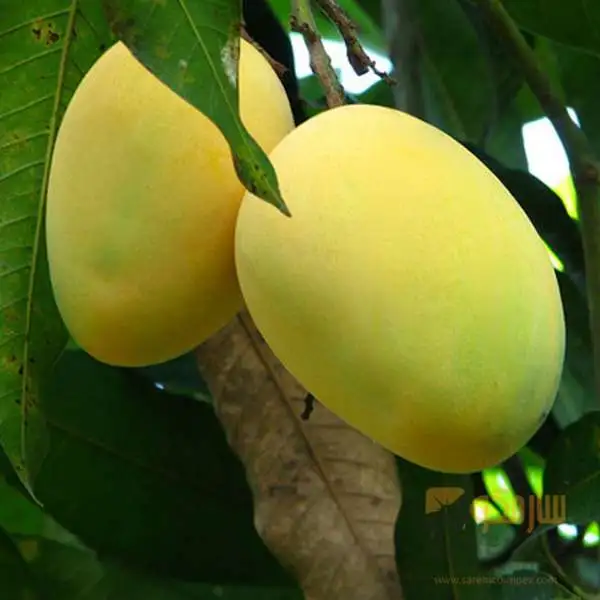
Kala chaunsa
- Its plants are tall and show irregular fruiting.
- The average weight of the fruit is 250g.
- After ripening the color of the pulp becomes yellowish and it is very soft.
- The sweetness in the fruit is 25-26%.
- The average yield of the plant is 300kg.
- This variety of mango is also slightly suitable for cultivation in salt affected soils.
- Its shelf life is very short.
- It is suitable for selling in local markets.
- Its area is rapidly decreasing in Punjab.
- At present it is cultivated on 7% of the total area.

Growth Calendar of Mango
| Month | Activities |
|---|---|
| January |
|
| February |
|
| March |
|
| April |
|
| May |
|
| June |
|
| July |
|
| August |
|
| September |
|
| November |
|
| December |
|

Growth Stages of Mango
Vegetative Growth:
- Increase the duration of irrigation when the plants reach maturity. Stop irrigation when the intensity of heat decreases (below 36 degrees Celsius).
- Fruit-bearing plants can undergo three growth spurts in a year.
- During the blooming period, growth can occur after fruit picking and when the fruit reaches its full size.
- Growth slows down at the time of increase in fruit size, which prevents further growth after fruit harvesting and reduces the ability to bear fruits.
- The growth occurring during the flowering phase affects the quality of the fruit negatively.
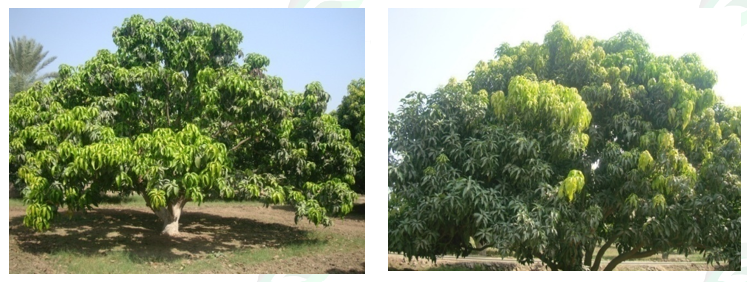
Root development:
- The root growth always occurs immediately after vegetative growth.
- Mango roots can extend to a depth of approximately 15 to 20 feet, but the depth of 5 to 7 feet is crucial.
- Roots up to a depth of 2 feet below the canopy of the plant are important for nutrient uptake.
- Presence of phosphorus and potassium in the soil is essential for root growth, while excessive moisture is not required. The timing and amount of root growth are regulated by hormones (auxins) that are produced in the upper leaves of plants and then move down to the roots.
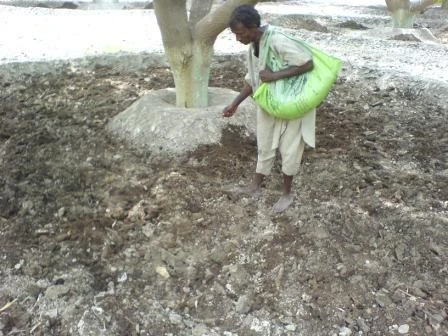
Dormancy:
- A good dormancy period of 4 months in deciduous plants leads to the best fruit production.
- After vegetative and root growth, plants enter into dormant phase.
- Hormones formed in the new branches keep them dormant for 3 to 4 months.
- During this period, plants do not require irrigation.
- In the dormant state, the branches undergo changes and develop buds. In Punjab, the dormancy period for mangoes is from November to February.
Flowering and Fruit development:
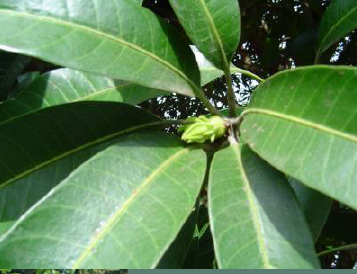
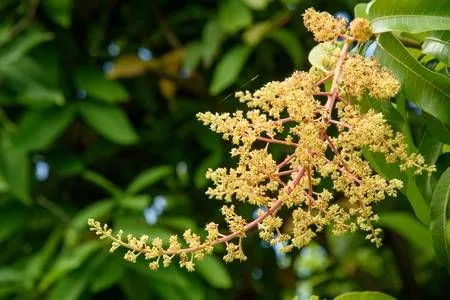
Development of more fruits and flowers is sign of good productivity. A healthy fruit prevents excessive vegetative growth on the plant, which improves the quality of the fruit. At flowering stage control pests and diseases promptly, apply boron spray on flowers, and ensure timely irrigation. In Punjab, when the night time temperature starts rising above 8 degrees Celsius during the second and third weeks of February, the process of flowering begins. Flowering initiates from the top of the plant where sunlight falls. The flowering and fruiting process completes by the first week of April. Fruit development is more pronounced in the third and fourth weeks of March. If the temperature in March exceeds 30 degrees Celsius, the fruiting process is adversely affected. To promote early fruiting, spray potassium nitrate on plants. The terminal buds of the flowers tend to produce fruits more effectively. There are 1,000 to 6,000 flowers in flower clusters. If 70 percent of the branches produce flowers, they contribute to good flowering. Initially, 0.1 to 0.5 percent of the flowers transform into fruit. Not all small fruits reach maturity; some drop off prematurely, accounting for 0.01 to 0.03 percent. The process of fruit setting in mango flowers occurs with the help of wind and insects. Using insecticides on the flowers reduces the fruit-setting process by 3 to 4 days. Breaking plant dormancy 10 to 15 days before the natural dormancy period ends stimulates them towards more fruit production. This way, the fruiting process completes before the onset of the hot season. To encourage immature branches towards fruiting, spray potassium, which induces flowering on younger branches and leads to more fruit setting. Immature mango branches have higher levels of gibberellic acid, which inhibits the flower formation process. In October, water scarcity and potassium spray, and in February, the use of potassium nitrate, direct the branches towards flowering.
Effect of temperature on growth stages of Mango
- Mango plant grow rapidly in hot humid weather and 25°c is the most suitable temperature for mango plant.
- Whereas if the temperature rises above 45°c, the growth stops, and the mango fruit may suffer from sunburn.
- Cold weather in winter stops the growth of mango trees, and induces them to bear fruit. But at temperatures below 4°c, chances of hail increase.
- When the temperature drops below 12°c during flowering, the pollination process is affected.
Pruning
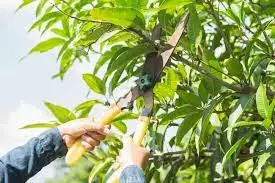
- Be sure to prune every year after fruiting.
- Cut off diseased, weak, insect infested and dry branches.
- Cut the branches that are on the ground.
- Do not cut from below the branch on which there is a bunch of leaves, but cut from the place where the distance between the leaves is greater so that the new branches are at some distance from each other.
Pruning Advantages:
- Good quality fruit with high production.
- Control of insect and diseases.
- Fruiting every year.
- Good quality and same sized fruit.
- Good shelf life after harvesting.
Mango Intercropping
After planting remove inflorescence for better vegetative growth up to four years and at age of five, keep inflorescence for fruit formation. During this period, intercrop can be taken as it help to give additional income also it help to reduce weed growth. For the last five years, the farmers have been intercropping improved mango fruit trees with food crops such as sorghum, cassava, sweet potatoes, nitrogen fixing legumes (beans and groundnuts) and indigenous vegetables.
- Do not grow crops that need much water.
- Give preference to fruitful crops.
- Do not grow long seasonal crops.
- Do not cultivate heighted/tall crops (millet, sugarcane, maize).
- Do not cultivate any crop in the garden after 80 years.
Soil and Climate
- Mango is grown in both tropical and sub-tropical conditions.
- It can tolerate a wide range of climatic conditions.
- For growing mango on a commercial and profitable scale the temperature and rainfall have to be with in a clearly defined range.
- In addition to altitude, temperature, rainfall and the wind velocity also influence growth and production of mango.
- It requires good rainfall during its growing season i.e. June to October and rainless, dry weather from November onwards.
- It can be grown on variety of soil. Deep soil without any hard pan up to depth of 4ft is, required for mango cultivation. pH of soil should be less than 8.5%.
Land Preparation
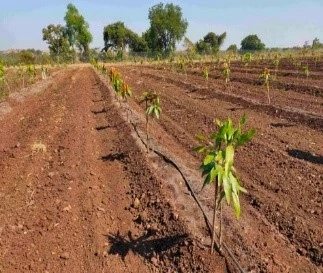
Do ploughing, cross ploughing of land and then levelled the land. Prepare land in such way that water stagnation should not occurred in field. After levelling take one deeper ploughing and then divide lands in blocks. Spacing is varied from place to place.
Sowing
Time of Sowing
Planting is done in month of August-September also in February - March. Do planting in cool hours of evening. Protect crop from high wind.
Spacing
Row spacing of 6-8m and tree spacing of 2.5-3.5m should be considered.
Sowing Depth
Dug pits of 1x1x1m size at distance of 9x9m one month earlier before planting. Expose them to sun. Fill with mixture of soil, 30 to 40 kg of FYM or Compost and 1 kg single super phosphate.
Method of sowing
Square and hexagonal planting can be adopted. Hexagonal planting accommodates 15% more plants.
Irrigation
During the water requirement period, irrigation become essential when 2/3 area under the tree canopy achieve dry friable conditions. The quantity of irrigation water can vary depending upon locality, temperature and soil type. Never irrigate wet soil as it causes root rot due to suffocation in root zone which ultimately reduce nutrition and water uptake. Each irrigation quantum should be of 3 acre inches for mango orchards.
Annual Irrigation Schedule
| Growth Stage | Irrigation Requirement/Month |
|---|---|
| Fruiting and Flowering Stage | Two time |
| Increase in Fruit Size | Three times |
| Development of new branches | Two times |
| Root elongation | One –two times |
| Dormancy | One times |
Monthly Irrigation Schedule
| Duration | Growth Stage | Number of Irrigations (25×35 ft plant canopy) |
|---|---|---|
| July-September | At harvesting and post-harvesting vegetative growth | The duration of irrigation is two to three weeks, but depending on the condition of the plant and the type of soil, irrigation should be stopped fifteen days before fruit picking. |
| October-January | Root growth and dormancy | Irrigation should not be carried out, however light irrigation is appropriate before frost. |
| February to March | Fruiting Stage | Irrigation should be done after two to three weeks depending on weather conditions. |
| April to August | Fruit growth and maturity | The duration of irrigation should be 10 to 15 days keeping in view the weather conditions. |
Fertilization
Fertilizer requirements per plant in Kg
| Age of Plant | Animal Waste | Urea | DAP/TSP | Potassium sulphate 50% | Gypsum |
|---|---|---|---|---|---|
| 6-7 year | 30 | 1.5 | 1 | 0.50 | 10 |
| 8-9 year | 40 | 2 | 1.25 | 1 | 10 |
| 10-12 year | 60 | 2.5 | 1.50 | 1.50 | 10 |
| 13-15 year | 80 | 3 | 2 | 2 | 10 |
| Above 15 years | 100 | 3 | 2 | 2 | 10 |
| Time of Application | At start of the month Dec/Jan | 70% after picking and remaining 30% at flowering | 100% after picking | 50% after picking and 50% after fruit setting | April-May |

Method of Fertilizer Application
- Apply fertilizer under the canopy of the plant where maximum water absorbing roots are present.
- Remove trashes from canopy so that fertilizer reaches the ground.
- Remove weeds.
Benefits of Paclobutrazol in Mango Orchard
- Plants do flowering early and in bulk quantity.
- With Paclobutrazol application plants do more fruiting.
- New branches appear in large amount after application of Paclobutrazol.
- Plant do fruiting regularly.
Weed management in Mango Orchard
- Summer weeds: It-sit, Khabal grass, madhana grass
- Winter weeds: Bathu, bili buti, jangli paalak and kundiaali
Management
| Weeds | Weedicide | Quantity |
|---|---|---|
| All type of weeds | Paraquat 20% SL | 200ml in 20litr water |
| All type of weeds | Glyphosate 48% | 300ml in 20litr water |
Mango Diseases and Their Control
Anthracnose
- It attacks on new branches, flowers and fruits.
- It is usually spread by rainfall.
- Its attack is increased specially during the flowering season.
- It spreads rapidly when the temperature is 23-25°c and the relative humidity in the air is 90%.
- Black spots appers on fruiting branches.
Chemical Control:
| Weedicide | Dose in 100litr Water |
|---|---|
| Copper Oxychloride | 250g |
| Copper Oxychloride+Kasugamycin 47% | 125g |
Powdery Mildew
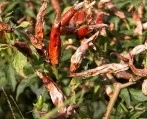
- It attacks panicle, flowers and leaves of mango, causing a superficial white powdery appearance on it.
- The disease is spread by wind and can spread very rapidly.
- Generally, the infection starts from the inflorescence and spreads downwards covering the floral axis, tender leaves and soft stem.
- Flowers fail to open, blacken or become brown, dry and may fall from panicles as they become completely covered by the fungus.
- Because of poor fruits set and heavy flower/fruits drop, the loss due to Powdery Mildew disease may be as high as 70-80%.
- Favorable environment is High humidity, cloudy weather & high wind velocity for 3-4 day.
Chemical Control:
| Weedicide | Dose in 100litr Water |
|---|---|
| Sulphur + Triadimefon 50% | 250ml |
| Azoxystrobin + difenaconazole | 100ml |
Sooty Mold Fungus
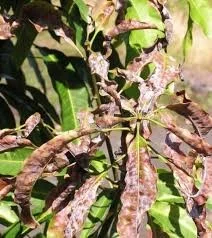
- Sooty Mould disease is recognized by the presence of a black sooty mould on the upper leaf surface.
- In severe cases, the leaves turn completely black due to the presence of mould over the entire surface of twigs and leaves.
- The fungus is responsible for this sooty mould formation. Honey dews secretions from sap sucking insects stick to the leaf surface and provide necessary medium for fungal growth.
- Although the fungus is non-pathogenic, causes no direct damage, but the photosynthetic activity of the leaf is adversely affected due to mold formation.
Chemical Control:
| Weedicide | Dose in 100litr Water |
|---|---|
| Sulpher+Triadimefon 50% | 250ml |
| Azokxystrobin+ difenaconazole | 100ml |
Black Spot
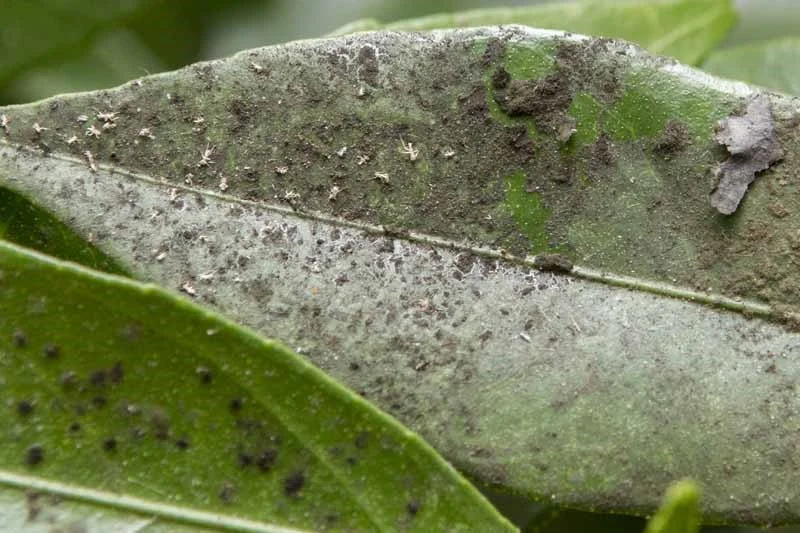
- The disease symptoms first appear as minute water soaked irregular lesions on any part of leaf, which later turns into irregular necrotic cankerous patches.
- Cankerous lesions also appear on petioles, twigs and young fruits.
- Water soaked lesions also appears on fruits, which later become dark brown to black with fruit cracking, accompanied by heavy bacterial exudation.
- Disease spread is rapid during rainy days.
- Disease development is favored by high humidity, moderate temperatures and high wind velocity.
Chemical Control:
| Weedicide | Dose in 100litr Water |
|---|---|
| Copper Oxychloride+Kasugamycin 47% | 125g |
Stem End Rot
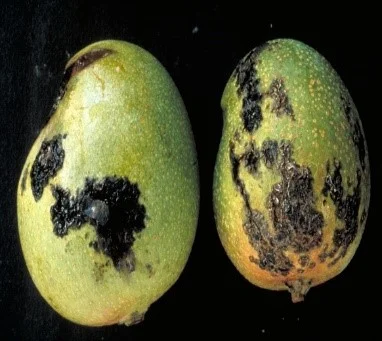
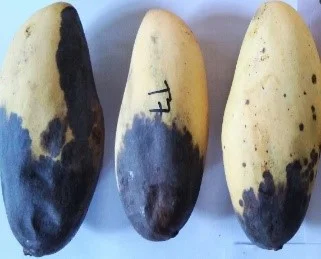
- This is a post-harvest disease of Mango.
- The fruit while ripening suddenly becomes brown to black typically at stem end as the disease symptoms appears first on pedicel part of the fruit.
- The rotting is so fast that the entire fruit rots within 2-3 days.
- The disease is observed on ripe fruits only.
- Nutritionally deficient plants are heavily affected.
Chemical Control:
| Weedicide | Dose in 100litr Water |
|---|---|
| Copper Oxychloride | 250g |
| Copper Oxychloride+Kasugamycin 47% | 125g |
Mango malformation
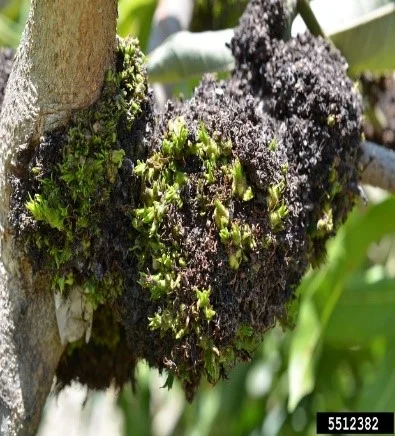
- The disease can cause abnormal flower, leaf and shoot growth.
- Mango Malformation disease can affect mango trees of all ages, though nursery plants are most susceptible.
- Crowing points such as leaf and stem buds produce misshapen shoots with short swollen internodes and brittle leaves.
- The flowering panicles instead of coming out as a normal one turns into compact bunch of hard flowers.
Chemical Control:
- Use of disease free planting material.
- Infected rootstock at nursery should be destroyed.
- As soon as the disease appears, the affected terminals along with the basal 15-20 cm healthy portion should be removed and burnt.
Mango Die-Back
- Mango die back is one of the serious fungal diseases of mango.
- The disease on the tree may be noticed at any time of the year but it is most conspicuous during October- November.
- It is characterized by drying back of twigs from top to downwards, particularly in older trees, followed by drying of leaves which gives an appearance of fire scorch.
- The infected plants show abundant gum secretion from branches, stem, and main trunk.
- Internal browning in wood tissue is observed when it is slit open along with the long axis.
- The affected leaf turns brown and its margins roll upwards.
- Cracks appear on branches and at this stage, leaf falls and twig/branch dies.
Chemical Control:
- Pruning dry branches.
- Make a strip of soil around the trunk of tree.
- This layer of soil has the ability to absorb the salts and thus the plants would gradually recover.
- If the disease is severe, make furrows 3 feet deep and 1.5 feet wide under the outer canopy of the plant.
- Fill this furrow with water every second in summer and every third irrigation in winter.
- By irrigating with canal water, these plants would get healthy quickly.

Insects and Their Control
Mango Mealybug
- They attack on every part of the plant.
- Sooty mould formation on mangoes due to mealybug infestation.
- The female adult mealy bug crawls down the tree in the month of April-May and enter in the cracks in the soil for laying eggs.
- Just after hatching, the minute newly hatched pink to brown colored nymphs crawl up the tree.
- After climbing up the tree, they start sucking the sap of tender plant parts.
- Only nymphs and female mealy bugs are harmful as they suck plant sap, male do not eat anything.
- They are considered more important because they infest the crop during the flowering season.
Chemical Control:
| Weedicide | Amount in 100litr Water |
|---|---|
| Clothianidin 20% | 100ml |

Mango Fruit fly
- Fruit flies attack at different stages of maturity but damage is more obvious at harvest stages.
- The female punctures the outer wall of the mature fruits with its pointed ovipositor and insert eggs inside the mesocarp of mature fruits.
- It is believed that fruit fly females carry bacteria with them that they inject into the fruit at oviposition so that the fruit decays, making it more nutritious for the larvae.
- After hatching, the larva feeds on the pulp of fruit which appears normal from outside, but drops down finally.
- The mature maggots fall down into the soil for pupation, the emergence of fruit fly starts from April onwards and the maximum population is recorded during May-July, which coincides with fruit maturity.
Chemical Control:
| Weedicide | Amount in 100litr Water |
|---|---|
| Alphacypermethrin | 100ml |
| Trichlorfon | 125g |
| Clothianidin 20% | 100ml |
| Carbosulfan+ Emamectin | 125ml |

Fruit Borer
- Grows on mango leaves, fruit and flower.
- The presence of holes in the fruit and discharge of secretions around them are among the symptoms of fruit borer.
- Females lay eggs from February to May on soft parts of plants.
- Borers used to make the fruit as food.
Chemical Control:
| Weedicide | Amount in 100litr Water |
|---|---|
| Emamectin + Lufenuron 3% | 200ml |
| Emamectin benzoate 1.9% | 200ml |
Leaf Minor
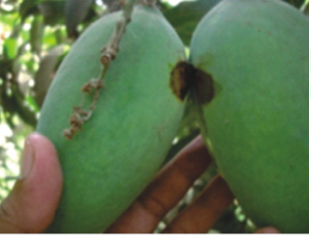
- This insect attack in April-May and October-November.
- Borers are lite yellow in color with brown head.
- They get the food from the upper and lower surfaces between the cells of the leaves due to which shiny bubbles appears on leaves.
- The attack causes blisters on the leaves.
Chemical Control:
| Weedicide | Amount in 100litr Water |
|---|---|
| Bifenthrin 10% | 150ml |
Mango Hopper
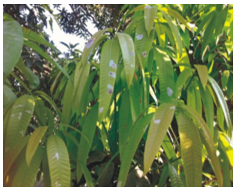
- Insect that cause most damage to mango orchard.
- It cause 50-60% yield reduction in case of severe infestation.
- It cause severe damage in the months of March and April.
- Adults emerge at the end of winter.
- Nymph appear in 4-7 days from eggs.
- Smart insects hatch from the eggs and starts to suck the sap.
- Two generations a year.
Chemical Control:
| Weedicide | Amount in 100litr Water |
|---|---|
| Clothianidin 20% | 100ml |
| Dinotefuran 20% | 100g |
Mango Midges
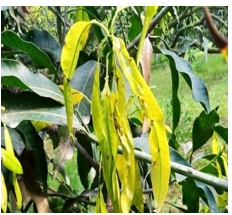
- Causes severe damage to small fruit.
- Very small in size and look like Thrips.
- Females are larger than males.
- The female bee lays about 1500 eggs inside the borer and small fruits.
- The adult die within two days.
- It mostly appear from Jan-April.
Chemical Control:
| Weedicide | Amount in 100litr Water |
|---|---|
| Bifenthrin 10% | 150ml |
Tumor-Farming Insect
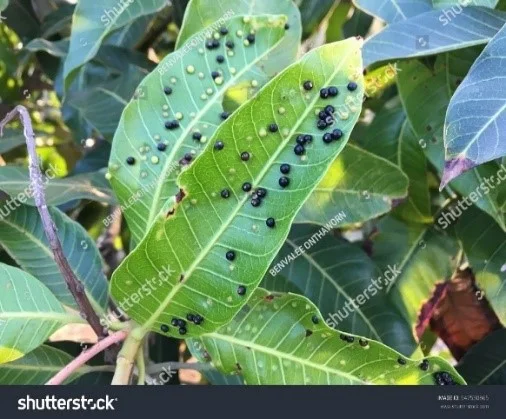
- The female lay eggs in leaves and cells.
- The cell around the eggs swell and form tumors due to the toxic substances.
- After drying the tumor leaves fall to the ground.
- Severe attack is from November to January.
- This insect make tumors on leaves.
Chemical Control:
| Weedicide | Amount in 100litr Water |
|---|---|
| Bifenthrin 10% | 150ml |
| Lambda Cyhalothrin2.5% | 75-100ml |

Thrips
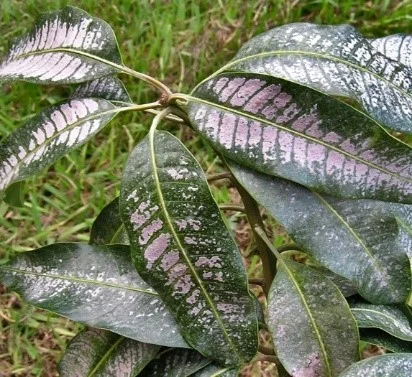
- Very small size and sucking insects having 1mm size.
- Affect small fruits and new leaves.
- It usually attack two times in a year.
- Infected plants turn white and brown and begin to wilt.
Chemical Control:
| Weedicide | Amount in 100litr Water |
|---|---|
| Chlorfenapyr | 100ml |
| Emamectin | 200ml |




.webp)
