Sunflower Production Plan By Growtech
Importance
Being an important oilseed crop, seed contains 40 – 45% good quality edible oil. It is a short duration crop (100 to 125 days), so usually cultivated as a cash crop for good return. Sunflower oil is good for heart patients as it contains 90% unsaturated fatty acids and is also a good source of vitamin A, B and K. Due to these qualities, this crop has a strong potential to contribute in the domestic edible oil market and can save huge import cost as well.
Land preparation:
Seedbed should be well pulverized and with adequate moisture supply for newly panted crop. A wide range of soil types is favorable for cultivation except sandy and waterlogged soil. It has well-developed tap root system and roots penetrate to the depth of 3 feet in the soil, that's why deep ploughing is necessary to break the hard soil pans. For this purpose, moldboard plough or disc plough should be used. Besides, land should be leveled using laser land leveler.
Time of sowing:
Crop can be sown through planter, single row cotton drill and kera method. Plant to plant distance of 9 inches and row to row distance of 2.25-2.5 feet should be maintained. Seed rate depends upon soil type, seed germination potential, time of sowing and method of sowing. 2-2.5 kg of hybrid seeds having more than 90% germination percentage should be used per acre. A plant population of 22000 – 23000 plants per acre should be maintained.
Approved Varieties
(Source: Government of Punjab)
| Variety 1 | Variety 2 |
|---|---|
| T-40318 | Orisun-648 |
| Agora-4 | Orisun-516 |
| Hysun-33 | Orisun-675 |
| NK Armany | Orisun-701 |
| US-444 | Parson-3 |
| US-666 | Sun-7 |
| Agson-5270 | HSF-350A |
| Agson-5264 | S-287 |
Seeds should be treated with Thiophanate methyl @ 2g per kg of seeds to protect the crop from various fungal diseases.
Sowing time according to area:
| North Punjab | North Punjab |
|---|---|
| Spring season | Fall season |
| 15th Dec – 31st Jan | 1st July – 10th Aug |
| Central Punjab | Central Punjab |
|---|---|
| Spring season | Fall season |
| 1st Jan – 31st Jan | 25th July – 10th Aug |
| South Punjab | South Punjab |
|---|---|
| Spring season | Fall season |
| 1st Jan – 15th Feb | 25th July – 10th Aug |
Fertilizer Recommendation
| Soil Fertility | Dose (Kg/ acre) |
|---|---|
|
Less fertile soil: • ˂ 0.87% organic matter • ˂ 7 ppm phosphorus and • ˂ 80 ppm potassium |
• Nitrogen: 60 kg • Phosphorus: 40 kg • Potassium: 25 kg |
|
Medium fertile soil: • 0.87% – 1.29% organic matter • 7 – 14 ppm phosphorus and • 80 – 180 ppm potassium |
• Nitrogen: 48 kg • Phosphorus: 34 kg • Potassium: 25 kg |
Sulphur:
Apply 80% sulphur @5 kg/ acre (12 kg ha-1) through flooding at bud formation stage. It increases the oil content in oilseeds.
Zinc and Boron:
In case of zinc and boron deficiency in soil after having soil analysis reports, 33% zinc sulphate @ of 6 kg/acre (15 kg ha-1) or 5% chelated zinc @ 2 kg/acre (5 kg ha-1) and 20% boron powder @125gm (313 gm ha-1) or 5% boron @500ml (1250 ml ha-1) can be applied at the time of sowing.
Irrigation
Four to five irrigations are generally required, depending upon the weather condition. Avoid water deficiency at grain formation stage, as it can cause reduction in size and weight of grains.
| No. of irrigations | Spring sown crops | Autumn sown crop |
|---|---|---|
| 1st irrigation | 20 days after emergence | 15 days after emergence |
| 2nd irrigation | 20 days after 1st irrigation | 15 to 12 days after 1st irrigation |
| 3rd irrigation | at flowering | at flowering |
| 4th irrigation | at grain formation | at grain formation |
| 5th irrigation | at milking stage | at milking stage |
Thinning:
Weak or abnormal seedlings should be uprooted before the first irrigation to maintain the desired plant population.
Weeds and their management
Intercultural operations are necessary to minimize the competition of sunflower plant with the weeds. Good yield can be achieved by providing weed-free condition to sunflower crop, up to 60 days after sowing. When the plant reaches the height of 1 foot, earthing up should be done along the rows. It safeguards the plants against lodging which is likely to occur at heading stage if winds of the high-velocity blow. Use Pendimethalin @ 800 ml/acre dissolved in 120 liters of water as a pre-emergence spray to provide effective control against weeds.
Disease and their management
Powdery mildew (Fungus):
Symptoms:
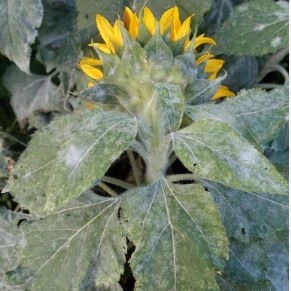
White powdery material (fungal growth) starts appearing on underside of the leaves, which under favorable conditions expands and covers the entire leaf. It may also spread on the back side of the head. As plant matures, black pin head sized structures are visible on infected parts of plant. The affected leaves turn yellow, dry up and die.
Control Measures:
Thiophanate methyl 70% @ 2 gram per liter of water Or Carbendazim % @ 2 gram per liter of water Or Penconazole @ 1 ml per liter of water
Downy mildew (Fungus):
Symptoms:
Downy mildew infected sunflowers have chlorotic leaves. Dense cottony, white masses of pathogen mycelium are apparent, generally on the underside of the leaves. Later on, the leaves become wrinkled, leathery and distorted. After reaching maturity, heads of infected plants do no, but characteristically face upward and produce few or no viable seed. The disease causes severe damage when crop is grown on heavy and wet soils.
Control Measures:
Thiophenate methyl 70% @ 2 gram per liter of water Or Matalyxyl + Mancozeb 72% @ 2 gram per liter of water Or Tebuconazol @ 2 ml per liter of water Or Copper oxychloride @ 2 gram per liter of water

Leaf blight (Fungal):
Symptoms:
This disease is characterized with brown spots on leaves, stem, and petals of the host plant. Spots develop into lesions and are dark-brown to black in color with a lighter margin and a yellow center. As the disease advances, the spots get increased in size and merge together to produce an asymmetrical lesion having chlorotic surrounding and necrotic center. The consequences of infection are blight, defoliation, flower and seed damage and ultimately cause wilting of the plant.
Control Measures:
Trifloxystrobin @ 1 gram per litre of water Or Tebuconazol @ 1 gram per liter of water Or Difenaconazol @ 1 ml per liter of water

Head rot (Fungus):
Symptoms:
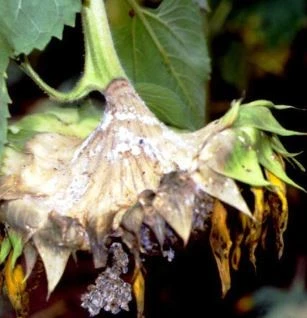
• In this disease, water soaked lesions of varying size start appearing on the back side of ripening head which later turn brown upon drying. These lesions become soft and pulpy and attract various insect pests. With the advancement of disease, sunflower heads dry out prematurely and tissues appear to shred. Greyish thread like strands of mycelium starts appearing inside the shredded tissues. The pathogen later produce black pinhead sized reproductive structure called sporangia, which appears as black powdery mask. These spores disperse into the air and infect other plants. It results in downward bending of head and lowering seed quality and ultimate low crop yield.
Control Measures:
Carbendazim 50% @ 2 gram per liter of water Or Thiophenate methyl 70% @ 2 gram per liter of water Or Matalyxyl + Mancozeb 72% @ 2 gram per liter of water
Stem or charcoal rot (Fungus):
Symptoms:
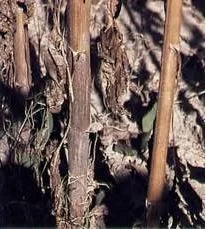
Due to wilting, affected plants develop grey discoloration at the base of the stem. Break down of cortex and pith gives shredded appearance to the lower stem where the development of irregular shaped microsclerotia occurs. This sclerotia surrounds the vascular bundles and restricts the flow of water and nutrients, which results in reduced seed size. The symptoms appear, when plants experience stress caused by low soil moisture or high temperatures.
Control Measures:
Carbendazim 50% @ 2 gram per liter of water Or Thiophenate methyl 70% @ 2 gram per liter of water Or Difenaconazol @ 1 ml per liter of water
Insects and their management
Termites
Symptoms:
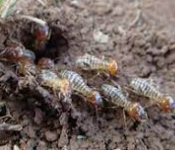
Termites are light brown in color and have ant-like appearance. They directly attack the roots and stem of plants. When roots and stem are being fed internally, they become weak. As a result, water and nutrients provision to plant is blocked. The plant dries up and lodging occurs.
Control Measures:
Apply Chlorpyriphos 40% EC @ 1.5 to 2 liter/acre (through flooding) Or Fipronil 5% EC @ 1 liter/acre (through flooding)
Grass hopper
Symptoms:
It directly attacks the crop and feeds on leaves and seeds, causing damage to vegetative parts and economic loss.
Control Measures:
Spray Lambda cyhalothrin 2.5% EC @ 250 ml/acre Or Bifenthrine 10 EC @ 250 ml/acre

Whitefly
Symptoms:
- Leaves give sickly appearance because both nymphs and adults suck the sap usually from the below side of the leaves and excrete honeydew.
- The leaf surface gets coated with sooty mold due to which the process of photosynthesis slows down, which eventually leads to stunted plant growth and shedding of fruit bodies. It is also responsible for the transmission of various viral diseases.
Control Measures:
Spirotetramate 240% EC @ 125 ml/acre Or Pyriproxyfen 10.8% EC @ 500 ml/acre Or Acetamiprid 20% SP @ 125 to 150 g/acre
.webp)
Jassid
Symptoms:
The insect is greenish yellow in color. Nymphs and adults suck sap usually from the underside of the leaves and buds due to which leaves dry up and shed. They also inject toxins causing curling of leaf edges and leaves turn red or brown. Chances of its attack are high in March and April (spring crop).
Control Measures:
Dinotifuron 30% SC @ 75 ml/acre Or Carbosulfan 20% EC @ 300 to 500 ml/acre
.webp)
Aphid
Symptoms:
This insect has greenish color. They form colonies on the under surface of the young leaves and suck sap from leaves and shoot resulting in crinkling and curling of leaves. Honeydew excreted by the insects gives shiny and sticky appearance to the leaves. Later sooty mold grows on honeydew and leaves may have a black coating.
Control Measures:
Abamectin 1.8% EC @ 400 ml/acre Or Carbosulfan 20% EC @ 500 ml/acre Or Bifenthrine 10 EC @ 250 ml/acre
.webp)
Mites
Symptoms:
Mites are light brownish in color and found in the form of colonies on the underside of the leaves. These suck sap from the leaves due to which leaves dries up and fall.
Control Measures:
Spirofesifen 240% EC @ 100 ml/acre Or Fenpyroximate 5% EC @ 200 ml/acre

Cutworm
Symptoms:
Cutworms are greenish brown in color with shiny black head. They damage the crop by cutting young plants near the ground surface during night.
Control Measures:
Bifenthrine 10% EC 400 ml/acre
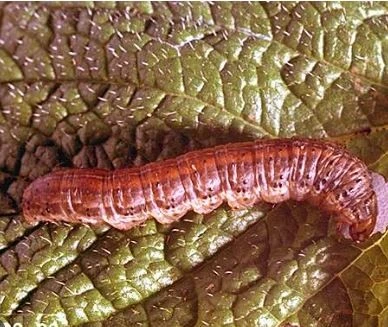
Army worm
Symptoms:
The caterpillar initially feeds on the foliage on underside of the leaves. In case of severe attack, larvae starts feeding on all plant parts causing extensive loss of leaves and crop.
Control Measures:
Emamectin benzoate 1.9% EC @ 200 ml/acre Or Flubendiamide 480 EC @ 50 ml/acre Or Leufenoron 5% EC @ 200 ml/acre Or Chlorantraniliprole 200% SC @ 50 ml/acre
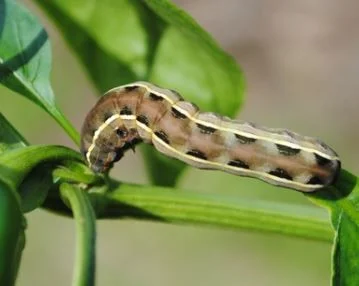
Helicoverpa armygera (American worm)
Symptoms:
Larvae feeds on the leaves and young shoots of the plants. In case of severe attack, it damages the flower by eating petals and sepals. During bud stage, it enters inside the flower and damages the pollen grains, which affects the pollination and seed development process.
Control Measures:
Emamectin benzoate 1.9% EC @ 200 ml/acre Or Flubendiamide 480 EC @ 50 ml/acre Or Spintoram 120% SC @ 80 ml/acre Or Chlorantraniliprole 200% SC @ 50 ml/acre
.webp)
Harvesting
The sunflower crop is ready to harvest when back of the head turns yellowish-brown and moisture content of the seed reaches 20 percent. Sickle should be used for harvesting the crop. Allow harvested heads to dry in sunlight for 3 for 4 days and then threshing should be done by using thresher or combine harvester. The commercial crop can be harvested with combine harvester and by adjusting its speed.




.webp)
