Turmeric Production Plan By Growtech
Importance
Turmeric is a perennial herb, native of south Asia. It is principal ingredient in Pakistani culinary and used as flavoring and coloring agent. It is used in drug and cosmetic industry because of its anti-cancer and anti-viral properties. Rhizomes are used for propagation. Its leaves are long, broad and of bright green color and flowers are of pale yellow color.
Land preparation:
To achieve a good yield of turmeric, it is essential to have fertile land with good water drainage, and the climate should be suitable. The field should be well-leveled to prevent waterlogging from irrigation or rainwater. About a month before planting, spread 25 to 30 tons of well-rotted manure per acre and irrigate the field. Maintain a spacing of 24 to 30 inches between rows and 8 to 9 inches between plants. Plant the turmeric rhizomes at a depth of approximately 2 inches using a hoe.
Sowing Method:
After planting, spread a layer of one inch of straw in the field so that the moisture of the soil remains sustained for a longer time. This will also help to maintain a lower temperature and protect the turmeric bulbs from the harmful effects of heat. This will result in better quality and higher yield. Turmeric's germination begins about a month and a half after planting, and it takes approximately one and a half months to complete. Turmeric can also be grown on raised beds spaced two and a half feet apart. However, crops cultivated on plain field give higher production.
Climate and Sowing Time
Turmeric cultivation requires moist and moderate water and weather conditions. The suitable time for cultivating turmeric in Punjab is the months of March and April, however the last fifteen days of March are the best.
Seed Rate:
For turmeric sowing, use 800 to 1000 kilograms of rhizomes per acre. It is even better to use round rhizomes with roots for seed.
Approved Variety:
The research institute for vegetables in Faisalabad has developed a new variety of turmeric named Mehk. Its yield potential is from 100 to 120 mounds per acre.
Fertilizer Management
Apply all the required amounts of phosphorus and potassium at the time of sowing. Use nitrogen fertilizers in three splits. First dose after 60 days of sowing, second after 90 days and third after 120 days of sowing.
| Soil Type | Quantity Kg/acre | Quantity Bag/acre |
|---|---|---|
| Average Fertile Land |
120kg N/acre 50kg P/acre 50kg K/acre |
4 bag Urea, 2 bag DAP, and 2 bag SOP |
Irrigation
Irrigate the crop immediately after sowing. However, make sure that water does not stand in the field, as it can cause the turmeric rhizomes to rot.
Weeds Management
The important weeds that emerges in the turmeric crop include Phlalaris minor, Amaranths viridis, pigweed, dactyloctenium aegyptium, and goosegrass, etc. Third day after plantation take spray of Atrazine@ 4-5 gm/liter on moist soil. To kill weeds that grow after first herbicide spray (12-15 days after plantation) take spray of Glyphosate@ 4-5 ml/liter of water. In May and June, a second sprouting of Cyprus rotundas occurs, which should not be eliminated because it protects the turmeric crop from intense heat and dryness.
Disease Management
1. Leaf Spot:
Symptoms:
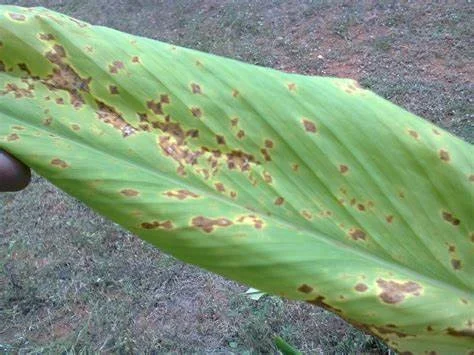
On the upper surface of small and new leaves, various-sized spots of brown color appear. The affected areas are irregular in shape, and the spots on the leaves become yellow or white in the middle. The spots merge together and later spread across the entire leaf.
Control Measures:
To control the disease spray Trifloxystrobin + Tebuconazole 75% @ 65 g/acre.
2. Leaf Blotch:
Symptoms:
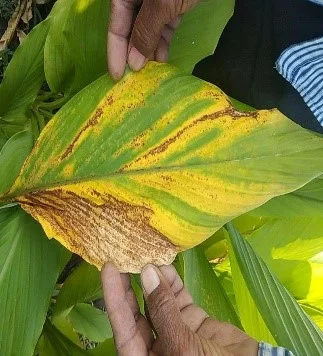
Brown spots appear on both sides of the leaves, which are small, oval, rectangular, or irregular in shape. After the spots become visible, the skin changes to a dirty yellow or brown color. At the end color of the leaves turns yellow.
Control Measures:
To control the disease spray trifloxystrobin + tebuconazole 75% @ 65g per acre.
3. Rhizome Wilt:
Symptoms:
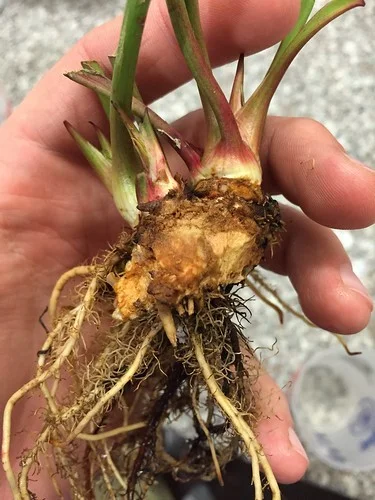
Plants show stunted growth. The lower leaves become dry, and their color turns brown. The plants above the ground level start to dry out.
Control Measures:
To control the disease flood Thiophanate methyl @ 1000g/acre flooding.
Insects and their Management
1. Stem Borer:
Symptoms:
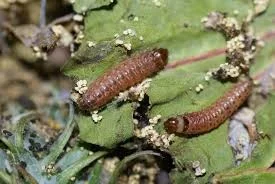
Its larvae feed on the shoots and utilizes them as a part of its diet. It makes small holes on the stems of plants.
Control Measures:
Flood Fipronil 80% @ 60g OR Fipronil 5% @ 960 ml per acre.
2. Leaf Roller:
Symptoms:
The caterpillar folds its leaves inwards and resides inside them, obtaining its food from the folded leaves.
Control Measures:
Spray Lambda Cyhalothrin @ 330ml in 100 litr of water.
Harvesting
In December and early January, the leaves of the turmeric plant completely dry up, signaling that the crop is ready for harvesting. Prior to the harvest, it is advisable to provide a gentle irrigation to the field. After three to four days, the actual harvesting process can commence. It's important to ensure that the soil is not excessively wet during this time, as overly moist conditions can lead to suboptimal harvesting and potentially make the process more challenging due to mud adhering to the rhizomes. In such conditions, the rhizomes may not detach easily from the roots and may risk breakage.





.webp)
